A crypto breakout screener should produce candidates to inspect, not orders to execute. Start with a precise price condition, then ask whether the volume comparison is meaningful and whether current liquidity deserves closer review. A large percentage gain alone does not answer those questions.
Our screener introduction explains the tool category. This article builds one original screening worksheet for upward breakouts. It is a manual teaching exercise, not a tested strategy, recommended parameter set or specification of CoinScreener features.
Fix the market and the candle
Choose the venue, full pair, instrument type, quote currency and timeframe before sorting results. Keep spot and perpetual markets separate. Use completed candles with consistent boundaries; an unfinished hourly candle is not comparable with a completed hour.
In this fictional review, four USD-quoted spot pairs on Venue V are assessed at 12:05:00 UTC. The signal candle is 11:00–12:00 UTC. Its reference window contains the twenty complete hourly candles immediately before 11:00 UTC. Twenty hours is an illustrative lookback, not an optimal setting.
A rolling high need not describe a tidy sideways consolidation. If your research requires a sideways range, define that extra condition before screening. Do not silently add it after seeing a chart you like.
Write the price test before adding filters
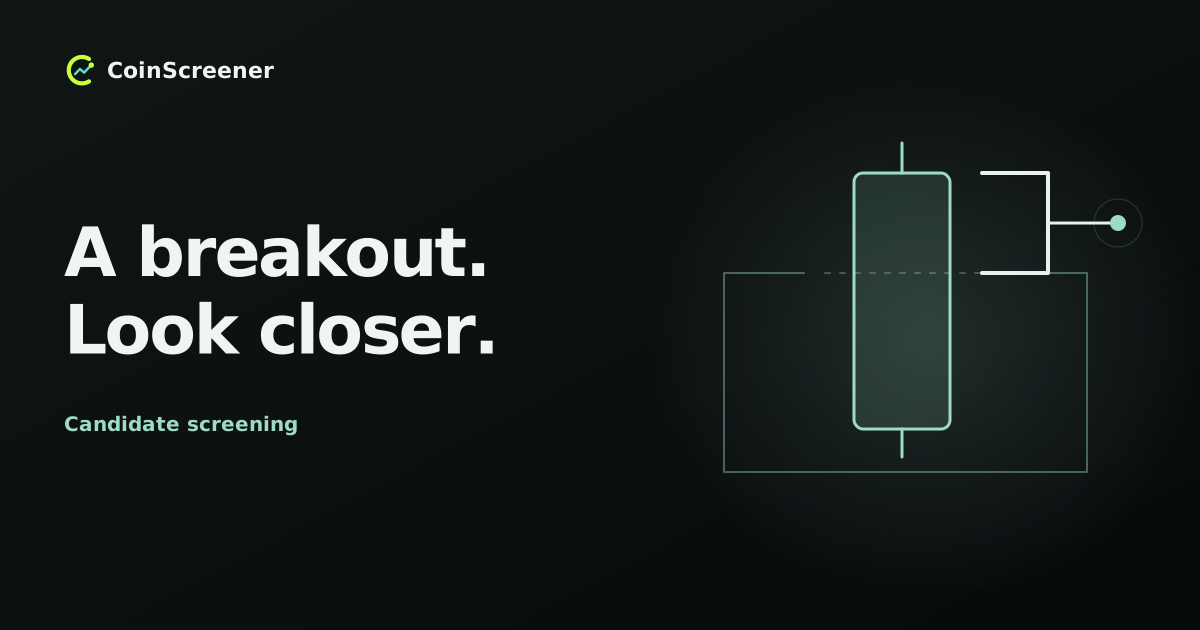
Let R be the highest high, including wicks, in those twenty prior candles. Let C be the assessed candle’s completed close. The price test is C > R. Exclude the assessed candle from R. A wick above R or a close equal to R fails this particular rule.
Save R with the observation: the rolling boundary can change later. The range-breakout guide covers the pattern and current product rules. The exercise here uses its own timeframe and selection criteria. If two venues disagree, our exchange-comparison lesson explains why; do not substitute one venue’s high for another’s.
Compare volume on the same basis
For this worksheet, divide the assessed candle’s base-token volume by the arithmetic mean of base-token volume in the same twenty prior hours. With a positive, complete baseline, 1,800 ÷ 1,000 = 1.8: the candle traded 1.8 times that market’s hourly average. This is a ratio, not a z-score or a success probability.
We require a ratio of at least 1.5 for this exercise’s shortlist. That arbitrary teaching threshold adds a selection preference; it does not define every breakout or imply that lower-volume moves must fail. Fidelity’s volume discussion explains comparing activity with earlier periods and considering seasonal differences. Its stock-market discussion is not evidence that our crypto threshold works.
Do not mix a rolling 24-hour total with one candle, or base-token volume with quote-currency turnover. Missing hours make this baseline incomplete; do not insert zero. Unusual volume can be temporary, and ratios from a quiet baseline can look large without substantial absolute activity.
Give liquidity a separate gate
Volume records completed activity. Coinbase’s order-book guide describes current bids, asks and quantities at each price. A volume condition cannot replace that information.
For a hypothetical buy of ten tokens, add two illustrative checks: spread no wider than 0.20% of the bid–ask midpoint, and at least 10 tokens of displayed asks from the best ask through 0.50% above it. Use a complete, timestamped book snapshot no more than five seconds old at review and already received; otherwise leave liquidity unresolved. These are teaching limits, not safe-execution guarantees.
The midpoint is (best bid + best ask) ÷ 2. Compute spread as (best ask − best bid) ÷ midpoint × 100. Ask depth is buy-side execution context only; it does not assess the bid depth needed to sell. Displayed orders may change before arrival, and fees, delay and slippage still matter. See the volume-versus-liquidity example for the underlying distinction.
Run every candidate through the same rules
All numbers below are invented. Each market has a verified R of 100 USD per token and complete price candles. A, B and C each have prior mean volume of 1,000 tokens per hour. D has incomplete volume history. All four book snapshots meet the five-second freshness check; depth means displayed asks inside the stated price band.
| Candidate and observations | Decision |
|---|---|
| A: C 101; volume 1,800; spread 0.10%; depth 25 tokens. | Accept for review. 101 > 100, ratio 1.8 ≥ 1.5, and both liquidity checks pass. |
| B: high 103, C 99; volume 2,000; spread 0.10%; depth 25 tokens. | Reject. The wick crossed 100, but 99 < 100. Ratio 2.0 cannot rescue the failed close. |
| C: C 102; volume 2,200; spread 0.80%; depth 3 tokens. | Reject. Price and ratio 2.2 qualify, but spread and depth both fail this review’s limits. |
| D: C 101; volume baseline incomplete; spread 0.10%; depth 25 tokens. | Unresolved. Price and liquidity pass; the required volume ratio cannot be verified. |
Only A reaches further review. D stays outside the accepted list until a complete baseline is available. B and C are rejected for this snapshot, not condemned as permanent bad markets. A later rally does not retroactively change what the screen knew.
Preserve the decision before the next scan
Record the rule version, market identity, candle boundaries, R, C, volume inputs, book timestamp, proposed size and decision reason. Keep failed and unresolved rows. This makes it possible to distinguish changed market conditions from changed screening rules.
For A, schedule a new review at 13:05 UTC after the next hourly candle is available; refresh the book and rerun the recorded rules. Keep the original snapshot alongside the new one. Use the daily-watchlist worksheet for ongoing review notes. Entry, invalidation, position size and total exposure still require a separate risk assessment.
Educational information, not financial advice. All markets and results in this exercise are hypothetical. Passing a screen does not establish a profitable trade, explain the cause of a move or guarantee an executable fill.