
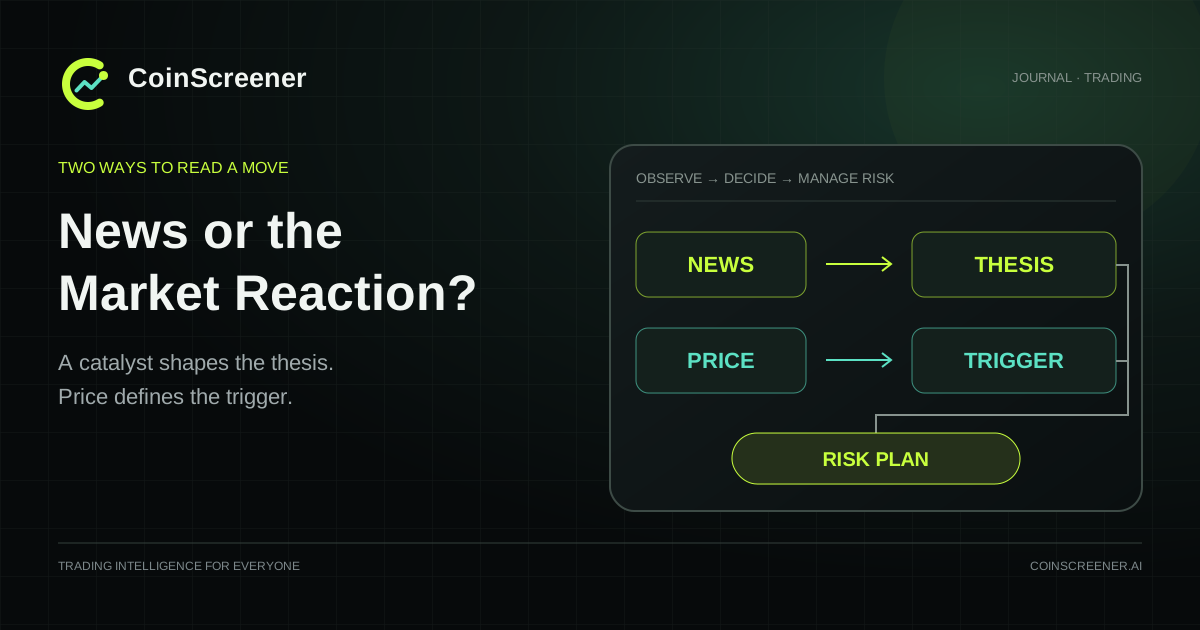
Event-driven trading starts with a reason the market might move. Technical trading starts with evidence in the market itself. The difference is what justifies a decision—not whether a trader reads headlines or opens charts.
In crypto, a trader might form a view around an inflation release, a token unlock or a protocol announcement. Another might act only after price breaks a defined range. A third combines the catalyst with a technical trigger. Each approach needs a way to decide that the idea is wrong.
Here, event-driven trading means trading around news or catalysts. The term also has a narrower institutional use covering corporate situations such as mergers; this article is about the news-versus-price decision facing a crypto trader.
What starts the trade: an event or a market condition?
An event-based thesis asks: what information could change expectations, and how might that affect this market? The trigger could be a confirmed announcement or a reported number that differs from a forecast. Entering before the event instead means accepting uncertainty about what will be announced.
A technical thesis asks: what observable behavior would justify acting? That might be a close above a previously defined level, a trend rule or a price pattern with a specified failure point. Technical analysis uses market data such as price and trading activity; Fidelity’s overview explains that distinction.
Neither approach is automatically a complete strategy. “The news is positive” does not specify an acceptable entry, and “RSI is rising” does not specify an exit. A strategy must connect its observation to an action and a risk limit.
A positive headline is not the same as a positive surprise
An announcement can sound favorable while delivering less than traders expected. It can also confirm something they had already positioned for. That makes “good news means price rises” an unreliable rule.
CME Group’s study of economic indicators explains why the difference between a forecast and the actual release matters. Its research concerns traditional futures markets, not a tested crypto trading strategy.
For a crypto event thesis, separate three questions: what was expected, what was actually confirmed, and how did the market react? If the third answer contradicts your prediction, consider that new evidence. A compelling explanation is not a reason to ignore your prewritten exit rule.
How technical indicators reflect the reaction
Indicators transform their input data. They do not read the announcement or know why someone traded.
- Price and volume show where trades occurred and how much traded in the market and interval measured. A volume jump does not identify the news responsible or prove who initiated it.
- RSI summarizes the balance of recent upward and downward price changes. A post-announcement move can change RSI, but the reading is not a score for how favorable the news was. See the RSI guide for the underlying concept.
- A moving average smooths price observations. It can turn after price has already moved; that delay is part of averaging, not evidence that it missed a headline. Fidelity’s SMA explanation describes this lag.
A chart can show behavior consistent with a news reaction, but the chart alone cannot establish causation. Nor does a technical setup require the trader to find a headline that explains it.
One hypothetical announcement, three different decisions
Suppose a fictional token trades between $98 and $100 before an announcement. After the release, it briefly reaches $103, then a 15-minute candle closes at $101. These are invented figures, not a historical trade or a backtest.
The event trader might act once the announcement satisfies a rule written beforehand. The reason for the trade is the new information. The risks include misreading the release and paying a much higher price than planned.
The technical trader might require a completed candle above $100, then wait for a pullback that stays above that level. The reason for the trade is the observed price sequence. Waiting may avoid an initial spike, but it can also mean missing a move that never pulls back.
The combined approach requires both the event condition and the technical trigger. It has more conditions to satisfy, but that does not automatically make it more profitable. It may reject trades that one approach would take.
If price then closes back at $99, the proposed break-and-hold condition has failed. If it instead runs straight to $108, the trader waiting for a pullback may remain out. Both outcomes belong in an honest evaluation of the rule.
A technical lesson from John Bollinger
John Bollinger, the creator of Bollinger Bands, makes a useful distinction in his published rules: touching a band alone is not a buy or sell signal, and a trending market can continue along a band.
Applied to our hypothetical announcement, a sharp rise reaching the upper band would not, by itself, establish a short trade. The lesson is about interpreting a tool within a method. It is not a claim that Bollinger endorses this example, trades this fictional token or guarantees a result.
Compare the trade-offs before choosing an approach
An event-based method asks for reliable information, a view of expectations and rules for acting when the release differs from the thesis. A technical method asks for consistent data, explicit triggers and tolerance for delayed or failed confirmation.
Both face execution costs. Around a fast move, slippage can separate the price on a chart from the price you actually receive. Confirmation does not remove that risk, and a stop order does not guarantee the planned exit price.
Compare approaches on the same market, period and cost assumptions. Include failed setups and trades you could not execute, rather than selecting only the screenshots that support your preferred style. A more convincing story is not a measured edge.
Write the decision before the market moves
Before the next event or setup, record:
- The observation: the exact announcement condition or market rule you are watching.
- The timing: what must be known before entry, including whether a candle must close.
- The trigger: what permits a trade, and what means standing aside.
- The failure condition: what invalidates the idea and how you intend to exit.
- The risk: acceptable loss, position size and an allowance for fees and imperfect execution.
Use the risk-management guide to connect those choices. Then review what was knowable at the time of each decision. Event-driven and technical trading can complement each other, but neither turns uncertainty into a promise.
This article is educational, not financial advice. The examples are hypothetical; no method or indicator guarantees a profitable trade.