A crypto market can look quiet right before it becomes difficult to ignore. Candles tighten, price moves sideways, and volatility contracts. Then the range opens.
That transition is what a crypto volatility squeeze alert is designed to surface. It does not predict whether price will rise or fall. It tells you that market behaviour has changed from compression toward movement, so you can inspect the chart before deciding whether there is a trade.
CoinScreener separates that process into three alerts: Volatility Squeeze, Squeeze Release, and Volatility Expansion. This guide explains what each alert means, how the detector works, and how traders can use the evidence without treating an alert as a guaranteed breakout.
What is a volatility squeeze in crypto?
A volatility squeeze is a period in which price movement has become unusually compressed. The market is still trading, but recent closes are clustering inside a relatively narrow range.
CoinScreener measures this by comparing two familiar volatility envelopes:
- Bollinger Channels respond to how widely recent closing prices are dispersed.
- Keltner Channels use Average True Range (ATR), which reflects the range travelled by price.
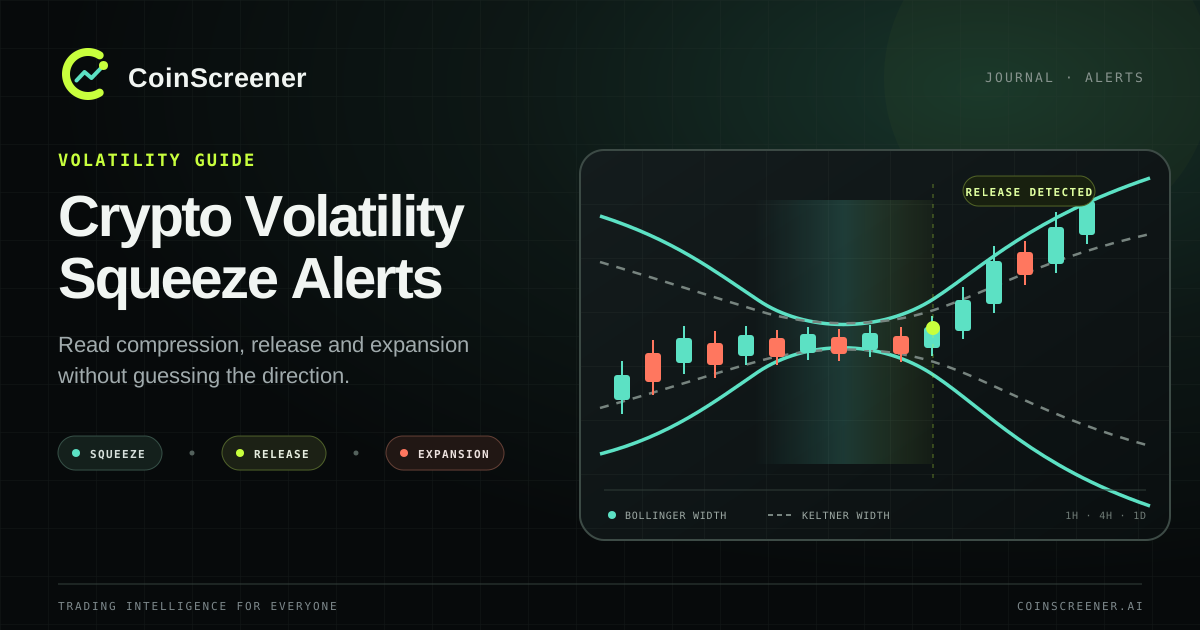
The detector uses 20-period calculations for both channels. A squeeze is active when the Bollinger width is narrower than the Keltner width—in chart terms, the Bollinger envelope sits inside the Keltner envelope.
That comparison matters more than a vague description such as “the chart looks quiet.” It gives the alert a defined, repeatable condition and evidence that can be shown on the event card.
The three CoinScreener squeeze alerts
CoinScreener models this area with three related conditions and keeps them separate so that one label does not have to mean three different things.
1. Volatility Squeeze: compression is active
A Volatility Squeeze alert means the Bollinger channel is currently narrower than the Keltner channel. Price movement has compressed relative to the recent trading range.
This is an observation, not an entry direction. A compressed market can eventually break upward, break downward, continue sideways, or briefly expand and then fail. The alert gives you a reason to prepare and inspect—not a reason to assume.
On the CoinScreener event view, the evidence includes the Bollinger and Keltner channel widths. The chart draws both envelopes and a separate width pane, making the comparison visible rather than hiding it behind a score.
2. Squeeze Release: the quiet condition just ended
A Squeeze Release alert fires when the current candle is no longer in a squeeze but the previous candle was. The Bollinger width has become equal to or greater than the Keltner width after compression.
This is often the stage traders care about most because it marks a change of state. Even then, release does not mean “buy” or “sell.” CoinScreener classifies it as non-directional and shows momentum as evidence so you can see how the latest candle moved.
Price structure still matters. A release into nearby resistance is different from a release through a well-tested range high. The same is true on the downside around support.
3. Volatility Expansion: movement accelerated sharply
A Volatility Expansion alert asks a stronger question: did the range widen fast enough to count as a meaningful acceleration?
CoinScreener flags expansion when the Bollinger width grows by at least 25% from the prior candle and the absolute one-candle momentum is greater than the current ATR. The interface shows both the width change and momentum behind the event.
Expansion can appear around a squeeze release, but it is its own condition. Keeping it separate helps distinguish “compression ended” from “the range is now widening sharply.”
Squeeze on vs squeeze release vs expansion
- Volatility Squeeze: Bollinger width is inside Keltner width. It does not tell you when the range will break or in which direction.
- Squeeze Release: the market moved out of compression after the previous candle was squeezed. It does not promise that the first move will continue.
- Volatility Expansion: Bollinger width jumped at least 25% and absolute one-candle momentum exceeded ATR. It does not tell you whether the move offers a good entry or acceptable risk.
Those conditions can occur in that order, but markets do not always move through them cleanly. A squeeze can persist. A release can fade. Expansion can happen without a fresh squeeze release. Read the alert that actually occurred, then inspect its context.
A practical crypto squeeze alert workflow
When a squeeze alert arrives, a disciplined review is more useful than reacting immediately.
Start with the conditions present
First identify which conditions are present: the market may be compressed, it may have just released, and it may be expanding. Release and expansion can occur on the same completed candle, while an active squeeze and a release cannot. Entering during compression risks waiting through more sideways action; chasing expansion risks entering after much of the move has already happened.
Confirm direction with price, not the alert name
All three CoinScreener squeeze alerts are intentionally non-directional. Use the chart to examine:
- whether price is breaking above or below the compressed range;
- nearby support and resistance;
- candle closes rather than intrabar spikes;
- momentum in the direction of the break; and
- whether volume or open interest supports the move.
This is also where other CoinScreener market-condition alerts can add context. An unusual-volume event can show increased participation, while an RSI extreme or divergence can warn that momentum and price structure deserve a closer look. These conditions can agree, disagree, or say nothing at all; none is automatic confirmation.
If you want a refresher on momentum, read How to use the RSI indicator in crypto trading.
Define invalidation before considering an entry
A breakout idea needs a point at which it is no longer valid. Depending on your method, that might be a close back inside the prior range, a break of the opposite boundary, or a level beyond recent structure.
Position size should follow that invalidation distance—not the excitement of the alert. Crypto derivatives can move quickly, and leverage turns a small analytical error into a larger account risk.
Watch for failed releases
One of the most common squeeze mistakes is assuming the first move must continue. Price can leave compression, attract breakout orders, and return to the range. Traders often call this a failed breakout or liquidity sweep.
Waiting for a candle close, checking structure, and deciding in advance what invalidates the idea can help you respond to what price did rather than what you hoped it would do.
Why timeframe changes the meaning
CoinScreener evaluates the squeeze family on 1-hour, 4-hour, and 1-day candles. A 1-hour squeeze may matter to an intraday trader, while a 1-day squeeze describes a much longer compression.
Do not compare the labels without comparing the timeframes. A daily squeeze can remain active while several 1-hour expansions occur inside it. That is not a contradiction; each alert describes its own candle series.
A simple approach is to use the higher timeframe for structure and the lower timeframe for execution. For example, a trader might note a 1-day squeeze, wait for a 4-hour release, and then decide whether the direction and risk fit their plan. This is a review process, not a prescribed strategy.
Common squeeze trading mistakes
Treating compression as a directional prediction
A squeeze says volatility is compressed. It does not know whether buyers or sellers will win the next move.
Entering before the market leaves the range
Compression can last much longer than expected. Entering too early may tie up capital or expose a position to repeated false starts.
Chasing a large expansion candle
By the time expansion is obvious, the distance to a sensible invalidation level may be too large. Passing on a poor risk-to-reward setup is still a decision.
Ignoring the close
CoinScreener evaluates completed candles. An intrabar wick outside a range and a candle that closes beyond it carry different information.
Assuming more alerts mean more certainty
Indicators often use related price data. Several alerts appearing together can add context, but they are not necessarily independent votes. Always inspect the underlying evidence.
How CoinScreener reduces alert noise
CoinScreener Alerts use deterministic rules: the squeeze detector—not an AI model—decides whether the condition occurred. The scanner evaluates completed candles and records changes in condition rather than repeatedly notifying on every pass while the same squeeze remains active.
A three-candle cooldown also limits repeated alerts when a measurement flickers around its threshold. That does not eliminate false breakouts, but it keeps the feed focused on meaningful state changes instead of turning one persistent condition into a stream of duplicates.
Explore CoinScreener Alerts and the evidence behind them or read why CoinScreener V3 separates Alerts from strategy Signals.
The useful question after a squeeze alert
The best question is not “Will price go up or down?”
It is: What changed, what evidence supports the move, and where would this idea be wrong?
A volatility squeeze alert can narrow your attention to a market transitioning from quiet to active. Your job is still to evaluate direction, structure, liquidity, and risk. CoinScreener is built to make that evidence easier to inspect—not to replace the decision.
Crypto assets and derivatives are highly volatile. CoinScreener provides informational tools, not financial advice. Alerts, Signals, AI explanations, and historical tests do not guarantee future results.