
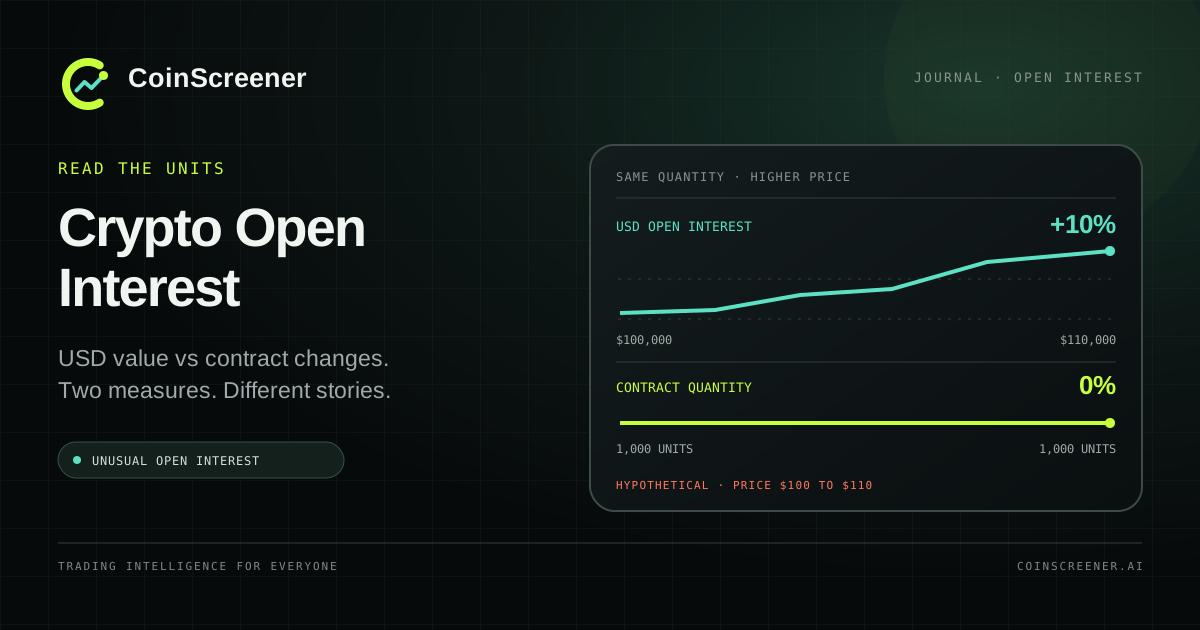
Crypto open interest in USD can rise even when the quantity of open contracts stays unchanged. Price affects the dollar value of those contracts. Before interpreting an OI increase as new positioning, check which measurement you are reading.
That distinction also explains a detail in CoinScreener's Unusual Open Interest alert: the displayed percentage tracks OI value, while the detector separately checks changes in contract quantity. Either test can make the condition active.
Open interest in contracts versus open interest in USD
Open interest measures outstanding derivative contracts. Volume measures contracts traded during a period. A contract has a long and a short side, but counts once in OI; an increase does not establish which side has the better trade. CME Group's volume and open-interest definitions explain that counting convention.
Two ways to express OI answer different questions:
- Contract quantity: how much remains open in the instrument's quantity units? Units depend on the contract specification; do not assume one unit always represents one coin.
- USD value: what is the dollar value of that outstanding exposure? This can change with both quantity and price.
Binance's USDⓈ-M open-interest statistics provide separate total-OI and total-OI-value fields. CoinScreener uses both for its Binance USDⓈ-M perpetual-market alert. This is venue-specific evidence, not a total of positions across every crypto exchange.
For a broader introduction, use the interactive open-interest guide. Here, the focus is the difference between the two measurements and what it means when reading an alert.
A price rise can lift dollar OI without new contracts
Consider a simplified linear contract where one quantity unit represents one unit of the underlying asset. These are hypothetical figures, not a historical trade or an exchange contract specification.
Start with 1,000 units open at a price of $100. Their notional value is $100,000.
- If quantity stays at 1,000 and price rises to $110, value becomes $110,000. Dollar OI rose 10%; quantity rose 0%.
- If quantity rises to 1,100 while price stays at $100, value also becomes $110,000. This time, the change comes from additional open quantity.
- If quantity rises to 1,100 while price falls to $90, value becomes $99,000. Quantity increased 10%, yet dollar OI fell 1%.
The third case is especially easy to misread. A small decline in dollar OI does not necessarily mean fewer contracts remain open. Price and quantity can offset each other.
These examples illustrate valuation arithmetic. They do not identify buyer intent, seller intent, margin deposited or the cause of a market move.
How CoinScreener tests for unusual open interest
CoinScreener's alert key is unusual_oi, displayed as Unusual Open Interest. Its detector evaluates two tests and combines them with OR: either can qualify. Increases and decreases are both eligible, and the alert's direction is neutral.
Test 1: an unusual USD value relative to its recent window
The detector calculates a z-score: the latest OI value minus the window's mean, divided by its population standard deviation. The window includes the latest observation. A flat window receives a score of zero.
The absolute score must exceed the timeframe's threshold. The latest value must also be a high or low of the last 12 observations, matching the sign of the score. A positive score needs a local high; a negative score needs a local low. Ties qualify as extrema.
This measures where the current dollar value sits relative to recent values. It does not directly measure how many contracts were added during the latest interval.
Test 2: a large change in contract quantity
Separately, the detector calculates the percentage change from the previous OI quantity observation:
Quantity change (%) = (latest quantity − previous quantity) ÷ previous quantity × 100
Its absolute magnitude must exceed the timeframe's percentage threshold. This test does not require a local high or low. A zero previous quantity produces no valid percentage comparison.
The current settings are:
- 5m: 288 observations; absolute value z-score above 3.0, or absolute quantity change above 3%.
- 15m: 96 observations; absolute value z-score above 2.5, or absolute quantity change above 5%.
- 1h: 72 observations; absolute value z-score above 2.0, or absolute quantity change above 8%.
- 4h: 48 observations; absolute value z-score above 1.8, or absolute quantity change above 10%.
The local-extreme requirement still applies to every z-score test. These are strict “greater than” comparisons, not “at least” thresholds. Daily and weekly Unusual Open Interest alerts are not configured.
What the percentage on the alert actually means
The V3 web and native clients define three OI evidence metrics:
- Open interest change: the percentage change in USD value from the previous observation.
- How unusual (z-score): the signed score of the latest USD value within its window.
- Open interest: the latest OI USD value.
The detector records the contract quantity and its percentage change separately, but those are not among these three standard displayed metrics. Do not compare the card's “Open interest change” percentage directly with the quantity threshold and assume the detector failed.
For example, on 1h, a hypothetical quantity change of −9% passes the quantity test even if the absolute value z-score is below 2.0. An alert can therefore be valid without an extreme displayed z-score. Conversely, a local high with a value z-score of 2.1 passes the value test even when quantity changes only 1%.
Those examples establish detector conditions, not a promise of a fresh event. The alert engine records a new inactive-to-active transition and applies a three-candle cooldown for the same detector, symbol and timeframe. A condition that remains active does not produce a new event on every scan. Crossing from one qualifying test to the other can keep that combined condition active.
Read the units before drawing a trading conclusion
When reviewing an OI alert, first check the symbol, venue, timeframe and measurement. Then compare price over the same interval. A dollar-value increase alongside a price increase deserves a different interpretation from a quantity increase with unchanged price.
Neither test identifies “more longs than shorts,” proves liquidation, or supplies an entry direction. Falling OI can accompany positions closing, but the aggregate measurement does not tell you why they closed. A neutral alert remains neutral even when its displayed percentage is strongly positive or negative.
Use support and resistance to put the price move in context. If volatility also changes, the squeeze-alert guide explains that separate observation. Several conditions appearing together still require a trading plan and a defined point of invalidation.
Explore CoinScreener Alerts with one question in mind: did the amount of open exposure change, did its dollar valuation change, or did both change? Keeping those questions separate makes an unusual OI alert much easier to interpret.
CoinScreener provides informational tools, not financial advice. Open-interest changes and other alerts do not guarantee a profitable trade.