
What it means
Ralph Nelson Elliott described a trend as five waves: three in its direction (1, 3 and 5) separated by two pullbacks (2 and 4). A five-wave count can only be checked once all five waves exist, so CoinScreener alerts at the end of the move, not the start. Distances are in ATR, the 14-candle average true range, so one rule fits calm and volatile markets.
Elliott Wave Top counts five waves up:
- Swings: every wave is a swing of at least 2 ATR. Smaller wiggles are not counted.
- Wave 0: the start is the lowest low of the previous 50 candles, so the count begins a move rather than a step inside one.
- The three rules: wave 2 stays above wave 0, wave 3 is never the shortest of waves 1, 3 and 5, and wave 4 stays above the wave 1 high.
- No truncation: wave 3 ends above wave 1, and wave 5 above wave 3.
- Length: wave 0 to wave 5 takes at most 120 candles.
- The close: the first close under the wave 4 low within 40 candles of wave 5, with no new high above wave 5 before it. The alert fires on that close.
Elliott Wave Bottom is the mirror: five waves down from a 50-candle high, the same three rules, and the first close above the wave 4 high.
In CoinScreener
Both alerts support 1h, 4h and 1D. A count spans up to 120 candles: about five days on 1h, three weeks on 4h and four months on 1D. Match the exchange, market and timeframe when comparing another chart.
Open Alerts and select Elliott Wave Top or Elliott Wave Bottom.
- Five-wave move: the distance from wave 0 to wave 5 as a percentage of wave 0. It is not a target or expected return.
- Wave 5 high / Wave 5 low: where the move ended.
- Wave 4 low / Wave 4 high: the level the close broke.
The chart draws the five waves, labels each swing 0 to 5 and carries the wave 4 level to the close that broke it.
Each count alerts once, on the close through wave 4. Overlapping counts on the same move do not alert twice; the larger one, with the earliest wave 0, is reported.
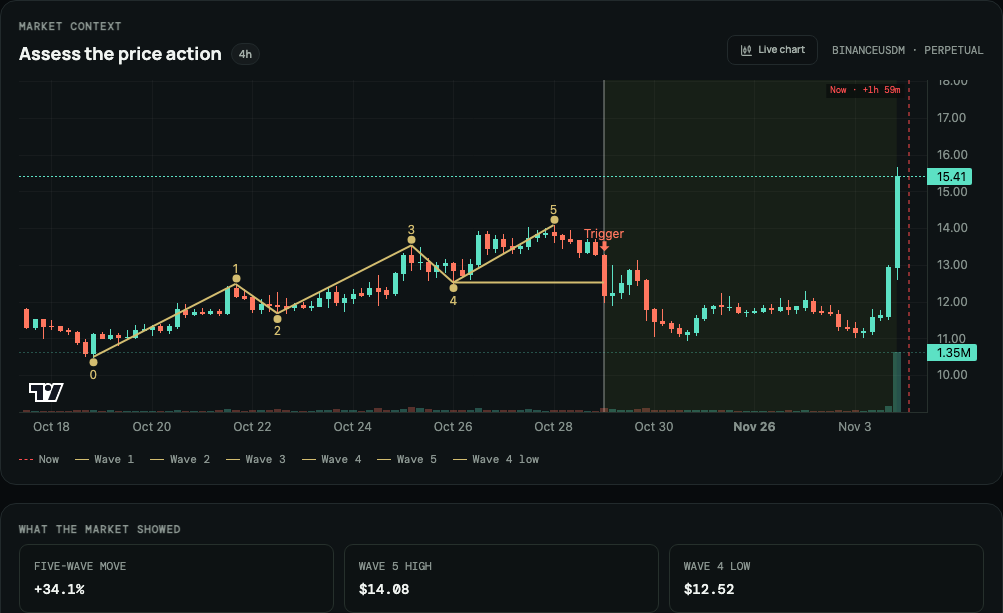
A recorded Elliott Wave Top in CoinScreener, with the five waves labelled 0 to 5, the wave 4 level carried to the breaking close, and evidence cards for the five-wave move, wave 5 high and wave 4 low. This is a historical replay example, not a live notification.
Three checks
- Treat wave 5 as the level that invalidates the idea: a new extreme beyond it means the move was still extending.
- Remember that Elliott's next stage is a three-wave correction, not necessarily a new trend, and a close back beyond the wave 4 level weakens the idea.
- Compare the current price with the wave 4 level, and set your own exit and size before any trade.
Explore examples
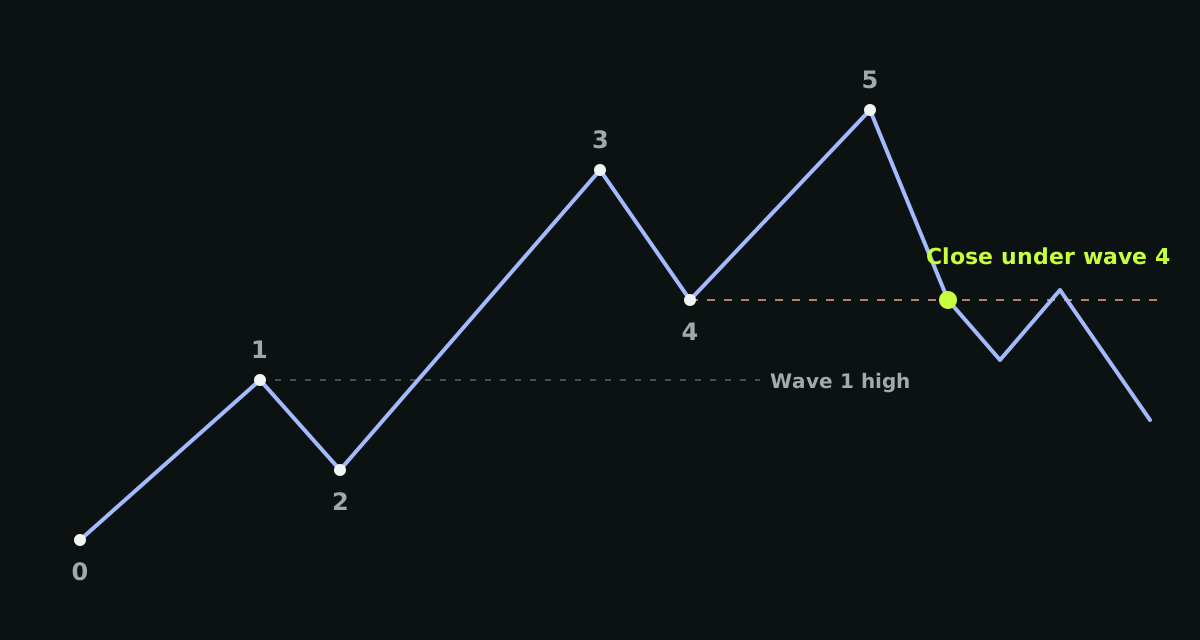
Read it left to right. A five-wave decline is the same drawing upside down. Only the close through wave 4 sends an alert.
Sources
Product behavior checked against V3 source on 4 November 2026. Screenshots retain their original capture dates.
StockCharts ChartSchool: Introduction to Elliott Wave Theory