What Polaris Meme offers
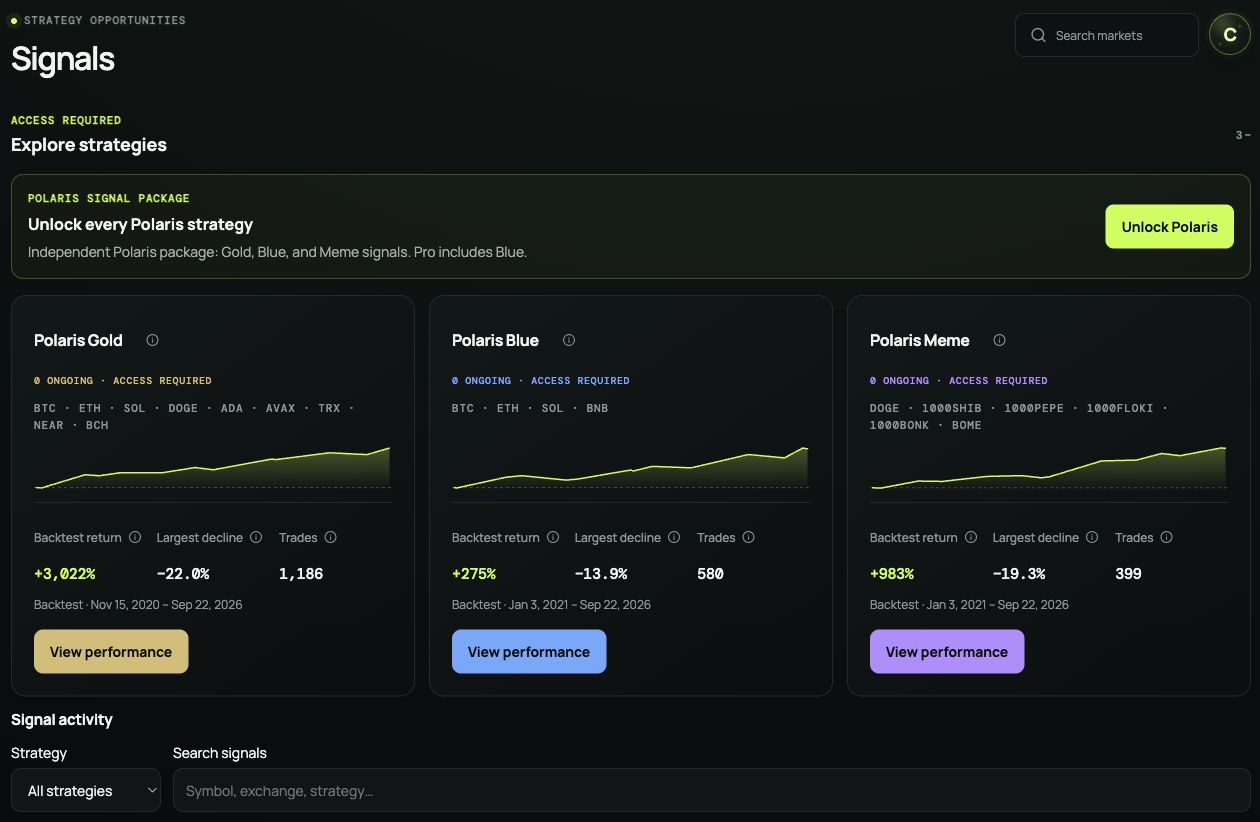
Polaris Meme looks for long opportunities in selected meme-token markets, where community attention and sentiment can change quickly. Its public market list, checked on 5 September 2026, is DOGE, 1000SHIB, 1000PEPE, 1000FLOKI, 1000BONK and BOME. Check the current strategy panel for coverage changes.
It looks for buying opportunities; this guide does not describe a short-selling product. A market being listed does not mean a position is always open or that a Signal will arrive on a predictable schedule.
The practical question is whether the displayed setup is still tradable at a price, size and level of risk that work for you. Pay particular attention to contract units and the liquidity available when you open the Signal.
Read the symbol and units carefully
A symbol prefixed with 1000 can refer to a venue contract quoted in a bundle of token units. It is not interchangeable with the spot token's per-token price. Instrument specifications, multipliers and price scales need to match the venue you use.
For a simple unit comparison, a quote of 0.02 per 1,000 tokens corresponds to 0.00002 per token. That conversion alone does not determine an order quantity: check the contract multiplier and the units expected by the exchange's order form.
Before calculating size, identify the exact contract and quote convention. Copying a level into another market with a similar name can create a very different order. The small-looking token price also says nothing about whether an asset is cheap or how large a position's notional exposure is.
What a Meme Signal shows
A long Signal provides reference trade levels, including an entry, a downside stop and any published target. Some setups have no fixed target. Use only the levels supplied and compare the reference entry with the price available now.
A sharp upward candle can increase the distance to the original stop and, when a target is given, reduce the remaining reward. It can also widen the spread between buying and selling prices or leave fewer orders available nearby. Check the cost of entering your intended size before acting.
Practise without chasing
Compare a hypothetical long, a stopped-out trade and a late entry. The prices are invented teaching units and are not Meme strategy outputs. There is no short scenario here because this product's public premise is long opportunities.
Before the setup
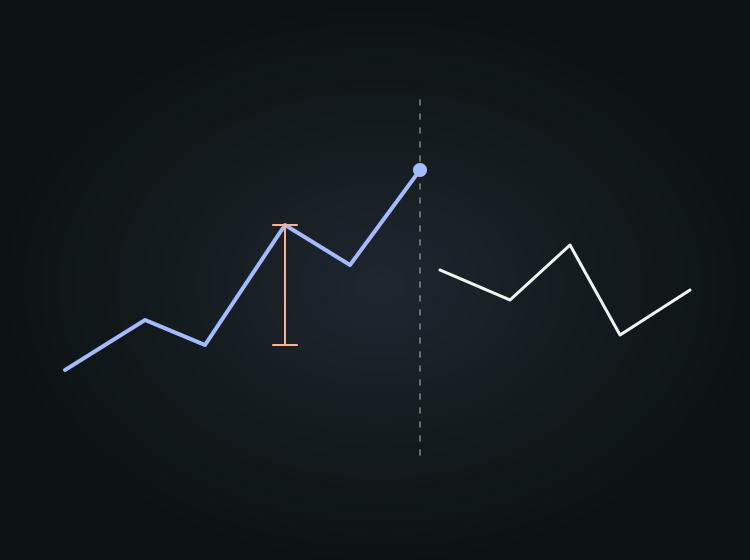
This hypothetical example will introduce an entry, stop and target. Watch when the levels become available, then compare the different outcomes. It is not a Polaris Signal.
Illustrated walkthrough · all scenarios
Long setup
- Before the setup. This hypothetical example will introduce an entry, stop and target. Watch when the levels become available, then compare the different outcomes. It is not a Polaris Signal.
- A hypothetical trade plan. The original idea has entry 100, stop two price units away and target four units away: 2:1 reward-to-risk before costs. A stop is an intended exit, not a guaranteed fill.
- Manage the risk you planned. An open trade's gain or loss is not a closed result. Review actual fills and total exposure; the chart cannot decide an appropriate size for your account.
- The target is crossed. The candle reaches the hypothetical target. The line crossing alone is not proof of your fill. Verify the trade status, execution and costs.
Stopped out
- Before the setup. This hypothetical example will introduce an entry, stop and target. Watch when the levels become available, then compare the different outcomes. It is not a Polaris Signal.
- A hypothetical trade plan. The original idea has entry 100, stop two price units away and target four units away: 2:1 reward-to-risk before costs. A stop is an intended exit, not a guaranteed fill.
- Manage the risk you planned. An open trade's gain or loss is not a closed result. Review actual fills and total exposure; the chart cannot decide an appropriate size for your account.
- The stop is crossed. The candle trades through 98. Real execution can be worse than the stop price because of gaps, slippage or liquidity. A losing outcome must fit the risk budget.
Late entry
- Before the setup. This hypothetical example will introduce an entry, stop and target. Watch when the levels become available, then compare the different outcomes. It is not a Polaris Signal.
- A hypothetical trade plan. The original idea has entry 100, stop two price units away and target four units away: 2:1 reward-to-risk before costs. A stop is an intended exit, not a guaranteed fill.
- The price has already moved. Entering at 102 with the original stop at 98 and target at 104 risks 4 to seek 2: only 0.5:1 before costs. The old reward-to-risk no longer describes this entry.
- The target is crossed. The candle reaches the hypothetical target. The line crossing alone is not proof of your fill. Verify the trade status, execution and costs.
The chart illustrates reference levels, not order-book execution. In a real market, a stop can fill below its intended price and a limit order may not fill at all. A touch of a target on a chart does not prove an order executed.
Timing and patience
As checked on 5 September 2026, Meme evaluates for new setups on a one-hour schedule. Evaluation tells you when it checks; holding duration tells you how long a trade stays open. Neither means a new Signal arrives every hour. Opportunities can cluster or be separated by long quiet periods.
Changing the chart interval does not change the published strategy. A discretionary trade made during a quiet period is not a Meme Signal simply because it uses one of the listed assets.
How to use it practically
- Verify the strategy, exact market symbol and quote-unit convention.
- Read the trigger time and compare current price with the reference entry.
- Check spread, available depth and whether your size could move the execution price.
- Calculate notional exposure and loss at the intended stop using the correct contract terms, then allow for worse execution.
- Check combined exposure across community-driven markets and any positions already held.
- Inspect the strategy's published evidence, including the history available for each market.
- Decide whether the setup remains practical; record actual execution separately if you act.
In the hypothetical lesson, entering at 102 instead of 100 doubles the distance to the stop at 98 while halving the reward to the target at 104. The same arithmetic applies at much smaller token prices when the units are consistent.
When to wait or skip
Skip when you cannot reconcile the quoted symbol with the instrument on your exchange, the order book is too thin for the intended size, or a market's movement makes a plausible stop fill too uncertain for the loss budget.
Be cautious about several related long positions. Community-driven markets can react together to broad sentiment changes. Different token names do not ensure independent exposure.
Do not increase size to compensate for a missed entry, remove the stop because a community is enthusiastic, or infer guaranteed momentum from an unusually large volume bar.
Read the evidence with its history
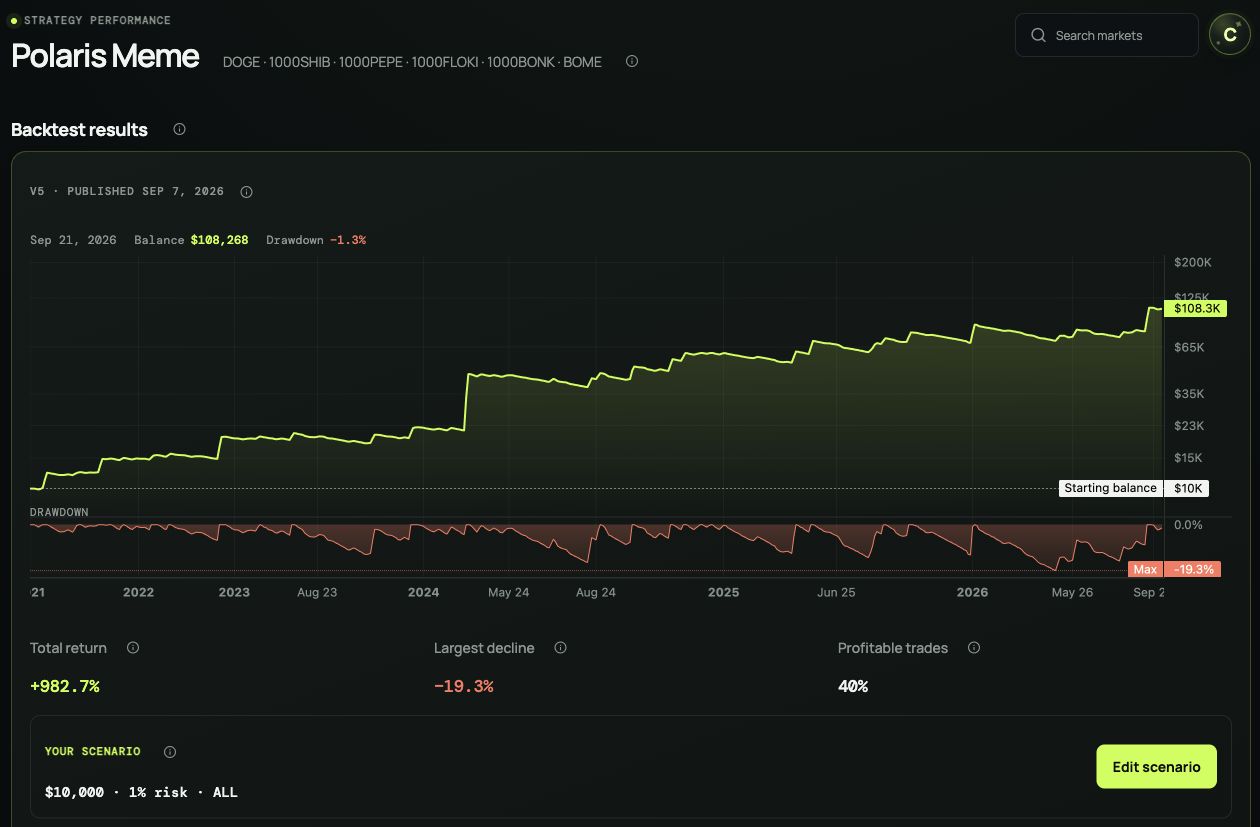
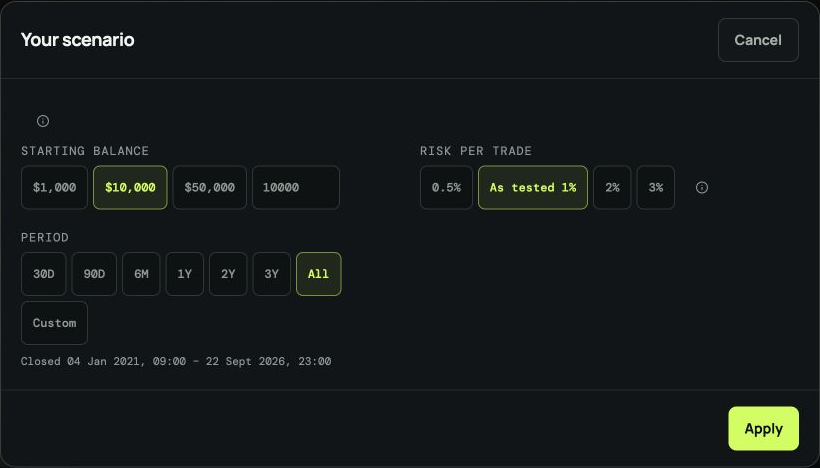
Open Meme's current Performance view for the published version, markets, dates, trade list and simulation assumptions. Some markets have shorter trading histories than established assets. A test cannot show how they would have traded during a crash or rally that happened before they were listed.
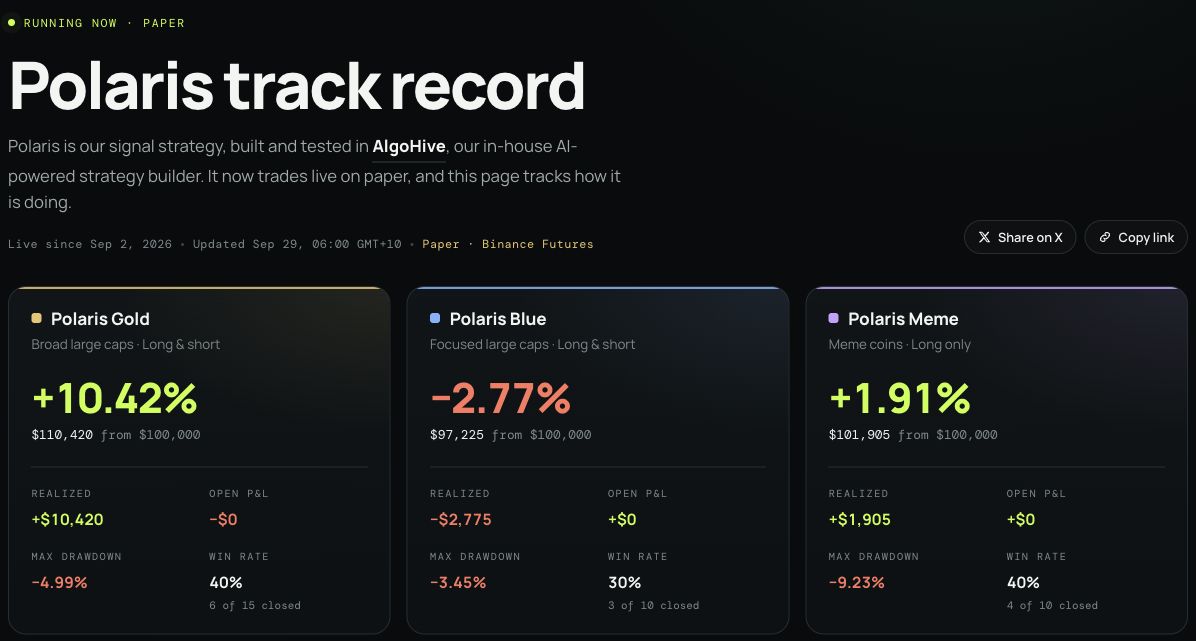
Inspect whether results depend heavily on a small number of strong moves. A profitable endpoint can coexist with deep drawdowns, long quiet periods and execution assumptions that deserve scrutiny. Historical simulation and live observations should be assessed separately.
The screenshot below illustrates the historical report at the time of capture. Check the current report's version and dates before drawing conclusions from those figures.

Check the historical period as well as return, drawdown and trade count. Meme markets can have shorter histories and different liquidity. These displayed results are a dated simulation, not a promise of live execution or returns.
A Meme checklist
- Correct instrument, token bundle and price units.
- Current entry and stop distance fit the loss budget.
- Spread, depth and plausible slippage checked for the proposed size.
- Total related long exposure considered.
- Historical coverage and assumptions understood.
- A clear decision to skip when execution is too uncertain.
Common questions
Does Meme take short positions? Its verified public premise is buying opportunities. Do not infer a short strategy from a bearish market move.
Does a low token price make a large quantity a small trade? No. Calculate notional exposure with the correct units and contract terms.
Can a stop always protect me during a fast drop? No. Gaps, liquidity and venue execution can produce a worse fill than the reference stop.
Product references
Public market coverage and strategy information were checked on 5 September 2026. Use the current strategy panel and Performance view for updates. Review risk management and volume interpretation to assess execution and activity alongside the setup.