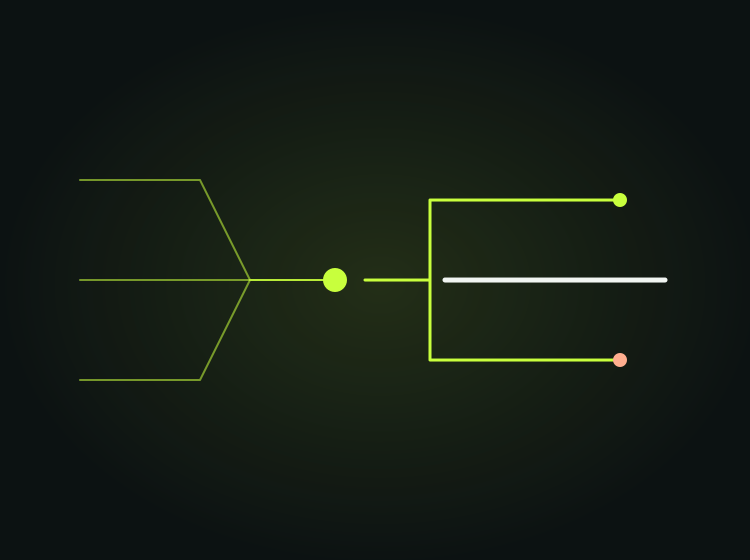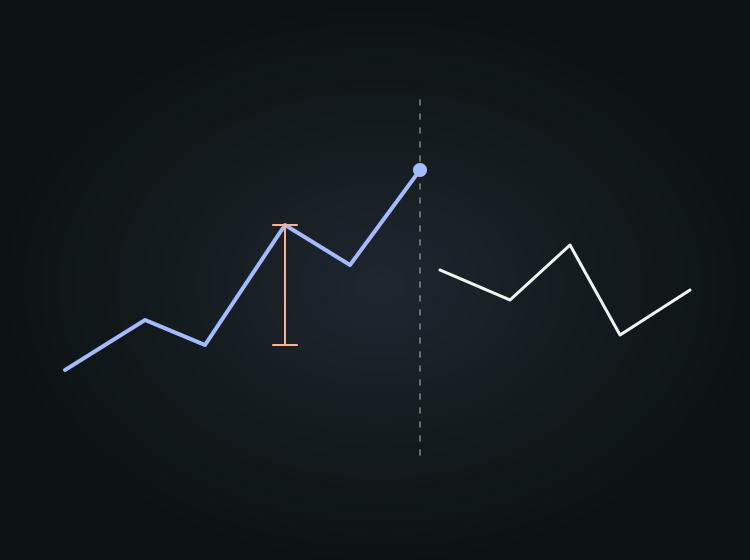
What Polaris Gold offers
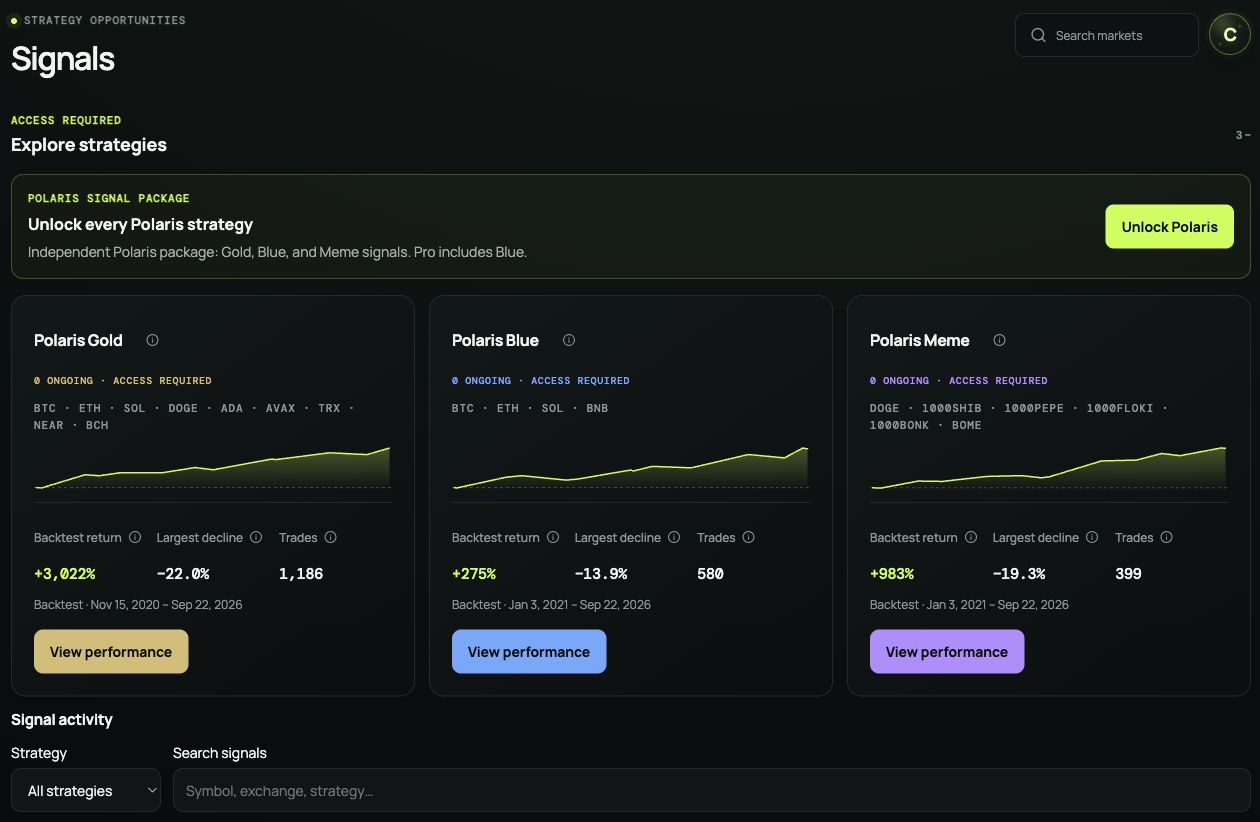
Polaris Gold looks for trading opportunities across a broader set of crypto markets than Polaris Blue. Its public market list, checked on 5 September 2026, is BTC, ETH, SOL, DOGE, ADA, BNB and AVAX. Check the current strategy panel for changes before assessing a new Signal.
The product offers both long and short setups across its portfolio. That does not mean every market supports both sides or that every market will produce an opportunity in each period. Read the direction of the actual Signal rather than inferring it from the product name.
Use this guide to read the displayed setup, assess the price available to you and check how a new position would fit alongside your existing trades.
What a Gold Signal shows
A Signal identifies the market, direction and reference trade levels. Read the entry, stop and any published target together. Some setups have no fixed target, so a target-based reward-to-risk ratio is unavailable. Assess only the levels and evidence actually shown.
Then check timing and current price. If price has moved substantially since the Signal, entering now can mean taking more risk for less remaining potential reward. The original setup may no longer fit the trade available to you.
Practise reading the setup
Explore the generic long and short examples, then compare a stopped-out trade with a late entry. These prices are invented for education and are not Gold outputs or rules.
Before the setup
This hypothetical example will introduce an entry, stop and target. Watch when the levels become available, then compare the different outcomes. It is not a Polaris Signal.
Illustrated walkthrough · all scenarios
Long setup
- Before the setup. This hypothetical example will introduce an entry, stop and target. Watch when the levels become available, then compare the different outcomes. It is not a Polaris Signal.
- A hypothetical trade plan. The original idea has entry 100, stop two price units away and target four units away: 2:1 reward-to-risk before costs. A stop is an intended exit, not a guaranteed fill.
- Manage the risk you planned. An open trade's gain or loss is not a closed result. Review actual fills and total exposure; the chart cannot decide an appropriate size for your account.
- The target is crossed. The candle reaches the hypothetical target. The line crossing alone is not proof of your fill. Verify the trade status, execution and costs.
Short setup
- Before the setup. This hypothetical example will introduce an entry, stop and target. Watch when the levels become available, then compare the different outcomes. It is not a Polaris Signal.
- A hypothetical trade plan. The original idea has entry 100, stop two price units away and target four units away: 2:1 reward-to-risk before costs. A stop is an intended exit, not a guaranteed fill.
- Manage the risk you planned. An open trade's gain or loss is not a closed result. Review actual fills and total exposure; the chart cannot decide an appropriate size for your account.
- The target is crossed. The candle reaches the hypothetical target. The line crossing alone is not proof of your fill. Verify the trade status, execution and costs.
Stopped out
- Before the setup. This hypothetical example will introduce an entry, stop and target. Watch when the levels become available, then compare the different outcomes. It is not a Polaris Signal.
- A hypothetical trade plan. The original idea has entry 100, stop two price units away and target four units away: 2:1 reward-to-risk before costs. A stop is an intended exit, not a guaranteed fill.
- Manage the risk you planned. An open trade's gain or loss is not a closed result. Review actual fills and total exposure; the chart cannot decide an appropriate size for your account.
- The stop is crossed. The candle trades through 98. Real execution can be worse than the stop price because of gaps, slippage or liquidity. A losing outcome must fit the risk budget.
Late entry
- Before the setup. This hypothetical example will introduce an entry, stop and target. Watch when the levels become available, then compare the different outcomes. It is not a Polaris Signal.
- A hypothetical trade plan. The original idea has entry 100, stop two price units away and target four units away: 2:1 reward-to-risk before costs. A stop is an intended exit, not a guaranteed fill.
- The price has already moved. Entering at 102 with the original stop at 98 and target at 104 risks 4 to seek 2: only 0.5:1 before costs. The old reward-to-risk no longer describes this entry.
- The target is crossed. The candle reaches the hypothetical target. The line crossing alone is not proof of your fill. Verify the trade status, execution and costs.
A stop two units from entry and a target four units away gives 2:1 price reward-to-risk before costs. If the available entry changes, that ratio changes. A chart line is not proof of an executed order in your account.
Timing and patience
As checked on 5 September 2026, Gold evaluates for new setups on a one-hour schedule. Keep three concepts separate: evaluation is when the strategy checks, chart timeframe is the interval you view, and holding duration is how long a trade remains open. An hourly check promises neither an hourly Signal nor an exit one hour later.
A selective strategy can go through long quiet periods. Changing the interval in the chart viewer helps you inspect price; it does not change Gold's published strategy. Keep any trades you choose independently separate from the strategy's record.
How to use it practically
- Confirm Gold is the strategy and read the actual market and direction.
- Check the trigger time, reference levels and current price.
- Assess nearby structure and whether the remaining reward justifies the realistic stop distance and costs.
- Calculate a size suited to your own loss budget and instrument terms.
- Add the proposed exposure to positions already open, including any Blue or Meme trades.
- Decide whether to enter, wait or skip; record actual fills separately from the strategy's reference result.
- Follow the recorded status and your own exit plan without assuming an open gain is final.
Gold's broader coverage makes the portfolio question particularly important. A BTC long and an ETH long may both be sensitive to a broad crypto decline. Counting them as two different symbols does not establish independent risk.
When to wait or skip
Skip when the notification is stale relative to the available entry, the setup's levels are unavailable, or existing positions already give you similar directional exposure. Wider market coverage is not a reason to take every idea.
Also skip when spreads, order size or venue differences make the reference prices unrealistic. Calculate risk from your likely entry and exit, including costs. A fast market can still produce a larger loss than planned.
Read the evidence
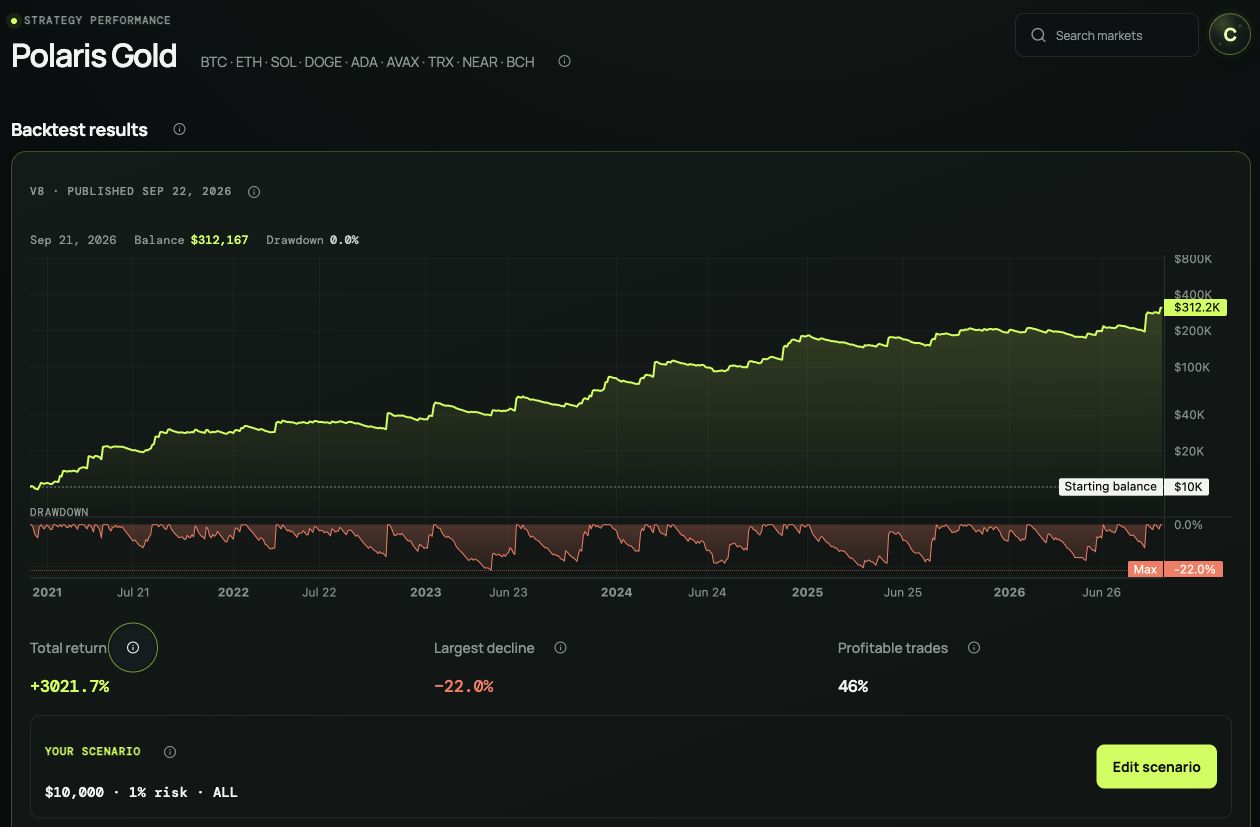
Open Gold's current Performance view for the published version, historical span, markets, assumptions and trade list. Review drawdown as well as return, and inspect whether results depend heavily on one market or period.
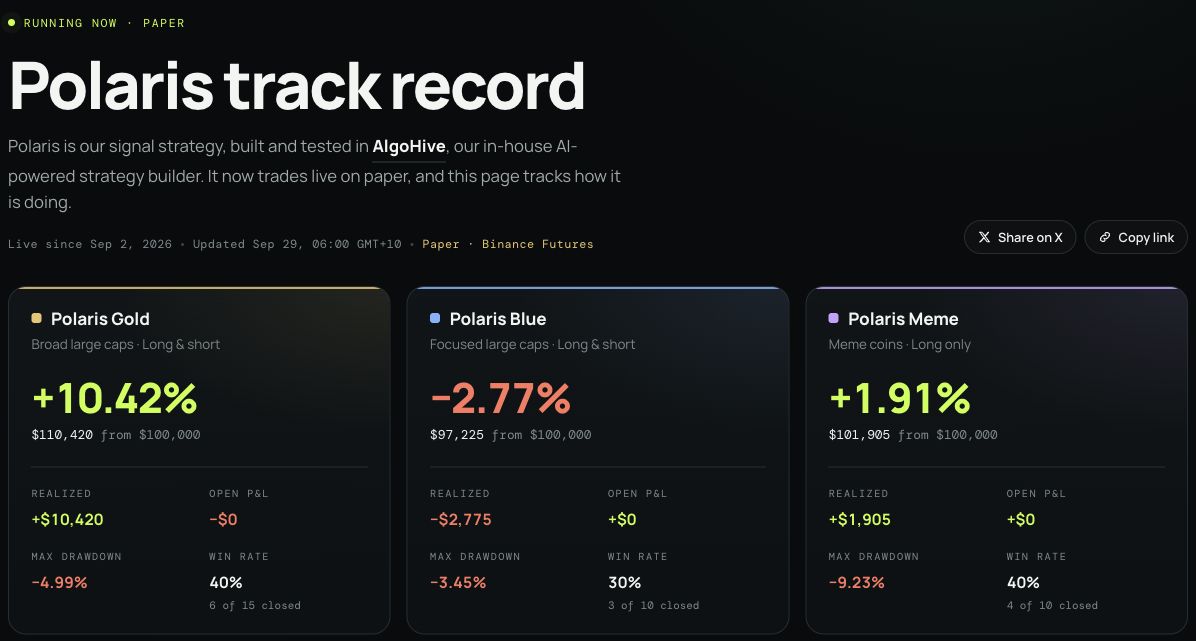
Read live observations separately from historical simulation. Your execution can differ from both. A strong historical number does not establish that the next Signal will win. The backtest guide explains a practical review order.
The screenshot below shows how to read that evidence. Its figures belong to the captured version and period; open the current Performance view for an up-to-date assessment.

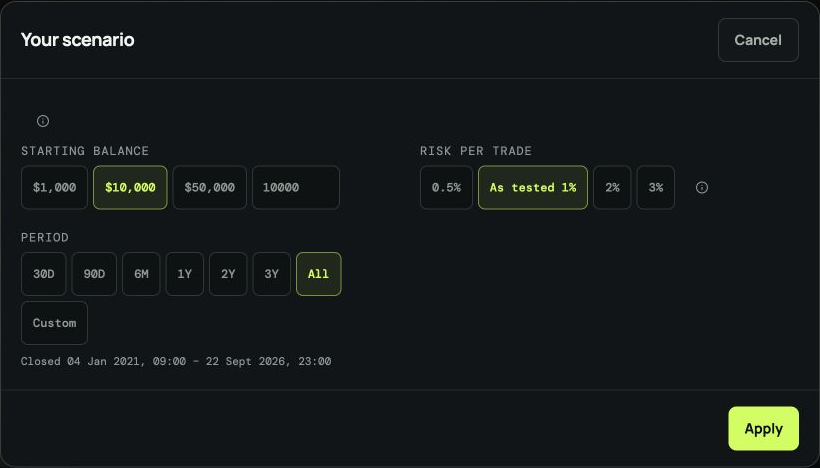
Gold’s Performance view pairs historical metrics with simulation costs, equity and drawdown. Review the full period and trade list rather than choosing from return alone. This is a dated historical simulation, not a live return claim.
A Gold checklist
- Correct strategy, market and side.
- Entry still practical after the notification delay.
- Size calculated from actual distance, costs and instrument terms.
- Exposure checked across all positions and strategy products.
- Historical and live evidence read separately.
- A clear reason to skip when the idea does not fit.
Common questions
Is Gold a recommendation to hold all seven markets? No. Its coverage describes where the strategy may look, not a required allocation or a guaranteed stream of trades.
Does Gold short every supported asset? Do not assume that. Read the direction of the actual Signal and the current public product information.
Is a Gold result the result I would receive? No. Timing, size, costs and execution can differ. Verify your own account records.
Product references
Public market coverage and strategy information were checked on 5 September 2026. Use the current strategy panel and Performance view for updates. Read Signals versus alerts before assessing a setup.