
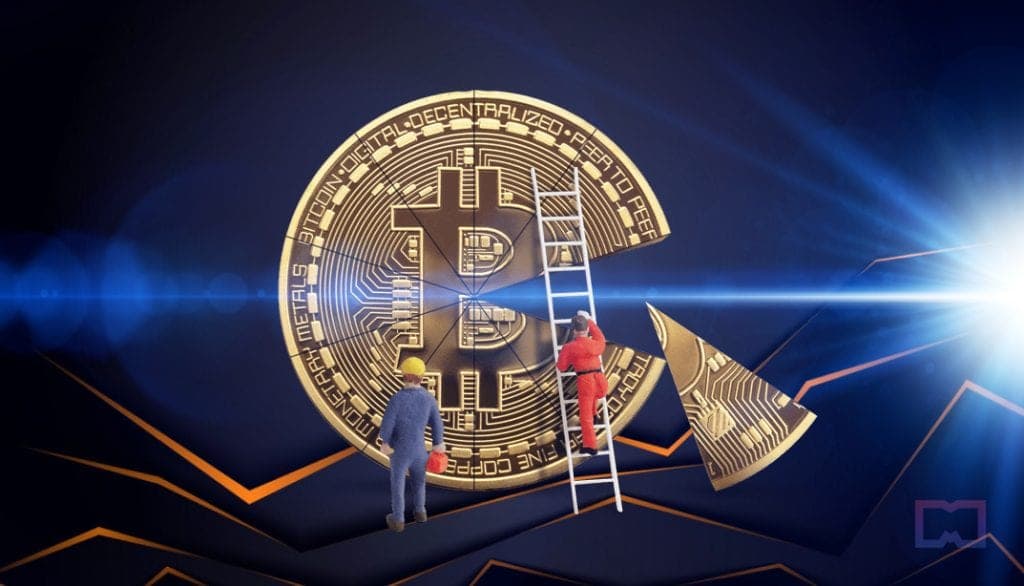
When the number of new bitcoins and the reward for mining them are halved, it is one of the most important occurrences on the Bitcoin network. The Bitcoin price rises with each half because less inflation is created.
In 2024, the block reward will drop to 3.125, marking the next halving. The effect of each successive halving of the block payment gradually decreases as it approaches zero.
What is Bitcoin Network
The Bitcoin network is a decentralized, peer-to-peer network that allows users to send and receive Bitcoins without the need for a centralized intermediary. The network is powered by a distributed network of computers, known as nodes, that work together to verify and process Bitcoin transactions.
When a user sends a Bitcoin transaction, it is broadcast to the network and verified by nodes through a process known as mining. Miners use specialized hardware and software to solve complex mathematical equations and verify transactions. Once a transaction has been verified and added to the blockchain, it cannot be altered or deleted.
The Bitcoin network is designed to be open and transparent, with all transactions visible on a public ledger known as the blockchain. This allows anyone to verify the validity of transactions and the total supply of Bitcoins in circulation.
Because the Bitcoin network is decentralized and operates independently of any central authority, it is not subject to the same restrictions and limitations as traditional financial systems. However, this also means that users are responsible for managing their own Bitcoin wallets and ensuring the security of their funds.
What is Bitcoin Mining
Bitcoin mining is the process by which new bitcoins are created, and transactions are verified and added to the blockchain. In order to mine bitcoins, miners use specialized computer hardware to solve complex mathematical problems, which require a lot of computational power.
These mathematical problems are part of the Bitcoin network's consensus mechanism, known as Proof of Work (PoW). Miners compete to solve these problems, and the first miner to solve the problem and verify the transaction is rewarded with a certain amount of newly created bitcoins. This reward is known as the block reward, and it is currently set at 6.25 bitcoins per block.
The mining process involves a lot of computational power and energy consumption, and as such, it can be expensive and time-consuming. However, mining is a crucial part of the Bitcoin network, as it ensures that the network is secure, decentralized, and transparent.
As the number of bitcoins in circulation approaches its maximum limit of 21 million, the mining reward will continue to decrease until it reaches zero, at which point miners will only be rewarded with transaction fees.
What Is Bitcoin Halving?
Bitcoin halving, also known as "halving," is a pre-programmed event occurring every 210,000 blocks, or approximately every four years, in the blockchain network. During this event, the number of newly minted bitcoins that are created as a reward for miners who successfully verify and add new blocks to the blockchain is cut in half.
The purpose of this process is to control the inflation of the Bitcoin currency by limiting the supply of new bitcoins that are introduced into the market over time. The total supply of bitcoins is fixed at 21 million, and the halving event ensures that the rate of new bitcoin issuance slows down over time until it eventually reaches zero.
The first Bitcoin halving occurred in 2012, when the mining reward was reduced from 50 BTC per block to 25 BTC. The second halving occurred in 2016, reducing the mining reward to 12.5 BTC per block. The most recent halving took place in May 2020, reducing the reward to 6.25 BTC per block. The next halving is expected to occur in 2024 when the mining reward will be further reduced to 3.125 BTC per block.
When Did Bitcoin Halvings Take Place?
There have been three Bitcoin halvings so far. Here are the dates of each halving:
- The first Bitcoin halving occurred on November 28, 2012, when the mining reward was reduced from 50 BTC to 25 BTC.
- The second Bitcoin halving occurred on July 9, 2016, when the mining reward was reduced from 25 BTC to 12.5 BTC.
- The most recent Bitcoin halving occurred on May 11, 2020, when the mining reward was reduced from 12.5 BTC to 6.25 BTC.
The next Bitcoin halving is expected to occur in 2024 when the mining reward will be further reduced to 3.125 BTC per block.
How Does a Halving of Bitcoin Work?
A Bitcoin halving is a pre-programmed event that occurs approximately every four years, or after 210,000 blocks have been added to the blockchain. Here's how a Bitcoin halving works:
- The mining reward is reduced: At the time of a halving event, the mining reward for each block is reduced by half. For example, the first halving reduced the mining reward from 50 bitcoins to 25 bitcoins, and the second halving reduced it from 25 bitcoins to 12.5 bitcoins.
- Decreased supply: As a result of the halving, the rate at which new bitcoins are produced decreases. This means that the total supply of bitcoins that will ever exist is gradually reduced, making it a deflationary asset.
- Increase in competition: With reduced mining rewards, there is an increased competition among miners to verify transactions and add them to the blockchain. This can lead to a higher hash rate and a more secure network, as more miners join the network to earn the remaining rewards.
- Potential price impact: A Bitcoin halving event can have a significant impact on the price of Bitcoin, as it can affect the supply and demand dynamics of the market. Some investors and traders may speculate on the potential impact of the halving on the price of Bitcoin, which can lead to increased market volatility.
- Cycle repeats: After a halving event, the mining reward continues to decrease until it reaches zero, at which point miners will only be rewarded with transaction fees. The cycle then repeats itself approximately every four years until the maximum supply of 21 million bitcoins is reached.
Why Are Halvings Fewer Than Four Years?
Bitcoin halvings are designed to occur approximately every four years, or after every 210,000 blocks have been added to the blockchain. However, the actual time between halvings can vary slightly due to the nature of the Bitcoin protocol.
The Bitcoin protocol adjusts the mining difficulty every 2016 blocks, or approximately every two weeks, to ensure that blocks are added to the blockchain at a consistent rate of about one block every 10 minutes. This means that the time it takes to mine 210,000 blocks can vary depending on the overall hash rate of the network.
If the hash rate of the network increases, blocks are added to the blockchain more quickly, and the 210,000-block threshold is reached more quickly than four years. Conversely, if the hash rate decreases, blocks are added more slowly, and the 210,000-block threshold is reached more slowly than four years.
Therefore, while the Bitcoin halvings are intended to occur approximately every four years, the actual time between halvings can vary slightly based on changes in the network hash rate and the difficulty adjustment algorithm.
Halving Impacts Bitcoin Price?
Yes, Bitcoin halvings can have an impact on the price of Bitcoin, although the exact effect is difficult to predict and can vary from one halving to the next. Here are some ways in which a Bitcoin halving can potentially affect the price:
- Reduced supply: A Bitcoin halving reduces the rate at which new Bitcoins are created, which can make the existing supply more valuable due to its scarcity. If demand for Bitcoin remains constant or increases, the reduced supply could lead to an increase in price.
- Miner profitability: A Bitcoin halving reduces the rewards that miners receive for verifying transactions and adding them to the blockchain. If the cost of mining Bitcoin remains constant, this could make it less profitable for miners to continue mining, which could potentially reduce the hash rate of the network and make it less secure. However, if the price of Bitcoin increases enough to offset the reduced mining rewards, miners may continue to mine and the network could remain secure.
- Market speculation: Bitcoin halvings are often the subject of speculation and media attention, which can lead to increased trading activity and volatility in the Bitcoin market. Some investors and traders may speculate on the potential impact of the halving on the price of Bitcoin, which can lead to short-term price movements.
It's important to note that the impact of a Bitcoin halving on the price of Bitcoin is not guaranteed, and other factors such as market sentiment, global events, and regulatory developments can also affect the price of Bitcoin.
When all Bitcoins have been mined, what will happen?
The maximum supply of Bitcoin is 21 million coins, and as of February 2023, approximately 18.8 million Bitcoins have already been mined. The remaining Bitcoins will be gradually released through the mining process, with the last Bitcoin expected to be mined around the year 2140.
Once all 21 million Bitcoins have been mined, no new Bitcoins will be created through the mining process. However, miners will still earn transaction fees for verifying transactions and adding them to the blockchain.
At this point, the Bitcoin network will rely solely on transaction fees to incentivize miners to verify transactions and maintain the security of the network. Transaction fees are paid by users who want their transactions to be processed quickly and are based on the size and complexity of the transaction.
The Bitcoin protocol is designed to ensure that the total supply of Bitcoin gradually approaches 21 million over time, with a decreasing rate of new coins being released over time. This means that the last Bitcoin to be mined will not be released until the year 2140, so it's difficult to predict what the state of the Bitcoin network will be at that time. However, it's possible that transaction fees will become a more important part of the Bitcoin ecosystem as the mining reward decreases over time.
Conclusion
Bitcoin halving inflates the cryptocurrency's price and halves the flow of new bitcoins. The rewards system will continue until bitcoin's 21 million maximum is achieved in 2140. Miners will receive transaction fees afterward.
If you aspire to become a pro-crypto trader, then you have clicked at the right place. CoinScreener.ai advanced technical analysis and AI-generated signals, rich data sources from more than 1000 Future & Spot markets enriched by Machine Learning, and major cryptocurrency exchanges in the world to screen for market trading signals, monitor and analyze the trading behavior of Whales, Top Traders to identify the best market trends in real-time and make the most profit from your trade today.
Follow CoinScreener: https://linktr.ee/coinscreener.ai
#coinscreener #coin #screener #coinscreener.ai #crypto #ai #cryptosignals #cryptocoin #token #cryptoscreener #screenerapp #screenertool #tradingsignals #aitradingsignals #technicalanalysisscreener #technicalanalysis #tradingbot #cryptohopper #cryptobot #dcabot #robot #calculatorcrypto #btc #binance #liquidations #fundingrate #cryptoscreener #btcliquidation #cryptoliquidation #Liquidation #future #futuretrading #cryptocalculator #costbasic #fed #FOCM #Federalreserve #CEX #DEX #KYC #RSI #indicator #P2P #gridtrading #perpetualcontracts #perpetualfutures #slippage #offchain #onchain #halving