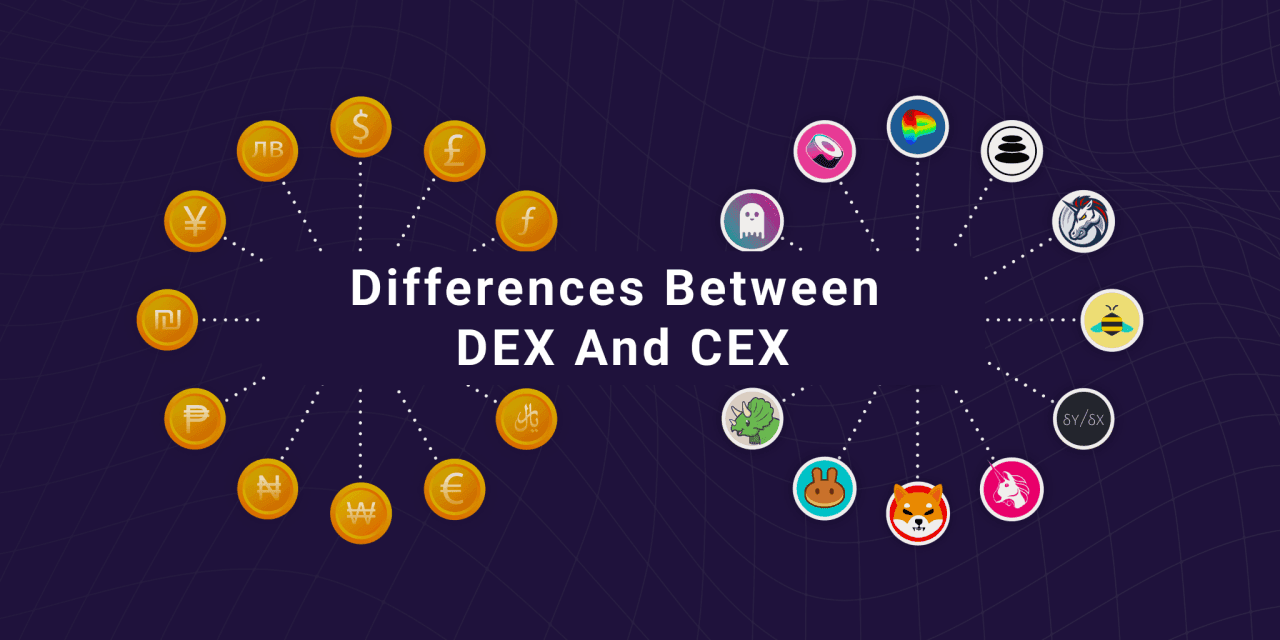
Decentralized financial solutions have boosted DEXs (DeFi). Traders are debating the pros and cons of Uniswap, a decentralized exchange, after its sudden transition (CEX).
Blockchain enthusiasts expect decentralized exchanges' customer base to explode in the next years. To distinguish transactions, several crypto exchanges are developing decentralized blockchain exchange platforms. As a user, do you believe cryptocurrency trading will decentralize?
First, though, let's have a theoretical grasp on the differences between Centralized Exchanges (CEX) and Decentralized Exchanges (DEX).
What is CEX (Centralized Exchanges)
CEX stands for Centralized Exchanges, which are platforms that facilitate the buying, selling, and trading of cryptocurrencies. In a centralized exchange, users deposit their funds into the exchange's wallets and trade on the platform's market. The exchange acts as a middleman and is responsible for managing the security of the assets held in its wallets, as well as executing trades on behalf of its users.
Some examples of popular centralized exchanges include Binance, Coinbase, and Kraken. Compared to decentralized exchanges (DEXs), centralized exchanges generally offer a more user-friendly interface, better liquidity, and more diverse trading options. However, because centralized exchanges are centralized entities, they are more susceptible to hacking, theft, and other security breaches, which can result in the loss of users' assets. Additionally, centralized exchanges often have more strict Know Your Customer (KYC) and Anti-Money Laundering (AML) requirements, which may not be appealing to users who value their privacy.
How does the centralized exchange work?
A centralized exchange (CEX) operates as a middleman between buyers and sellers of cryptocurrencies. When a user wants to trade cryptocurrencies on a centralized exchange, they need to deposit their funds into the exchange's wallets. The exchange then manages the security of the assets held in its wallets and executes trades on behalf of its users.
Here is a general overview of the process of how a centralized exchange works:
- Account creation: Users create an account on the centralized exchange by providing personal information, including their name, email, and proof of identity.
- Depositing funds: Once an account is created, users can deposit their funds into the exchange's wallets. This can be done by transferring cryptocurrencies from a personal wallet to the exchange's wallet or by purchasing cryptocurrencies directly on the exchange using a credit card or bank transfer.
- Trading: Users can buy, sell, or trade cryptocurrencies on the exchange's market by placing an order. There are two types of orders: a "buy order" and a "sell order." Buy orders are placed by users who want to purchase a certain cryptocurrency, and sell orders are placed by users who want to sell a certain cryptocurrency. When a buy order and a sell order match, a trade is executed, and the exchange takes a small fee for facilitating the transaction.
- Withdrawing funds: Users can withdraw their funds from the exchange's wallet to their personal wallet at any time. This process can take several minutes to several hours, depending on the exchange's policies and the network congestion of the blockchain that the cryptocurrency is based on.
In summary, centralized exchanges provide users with a platform to trade cryptocurrencies in a secure and convenient manner. However, users must trust the exchange to manage their assets and execute trades accurately, which can be a risk for some users.
What is DEX (Decentralized Exchange)
A DEX, or Decentralized Exchange, is a platform for trading cryptocurrencies that operates on a decentralized network, rather than being controlled by a central authority. In a decentralized exchange, users maintain control of their own assets and trades are executed directly between buyers and sellers, without the need for a middleman.
One of the key benefits of a DEX is that it offers a more secure and private way to trade cryptocurrencies, as users have full control over their assets and the exchange does not hold any funds. Additionally, DEXs are often less subject to regulatory restrictions and censorship, which makes them attractive to users who value privacy and freedom.
However, compared to centralized exchanges, DEXs generally have lower liquidity, slower trade execution times, and a less user-friendly interface. Additionally, because DEXs are not managed by a central authority, there is no one to assist users in case of technical issues or other problems.
Some popular examples of DEXs include Uniswap, Curve, and Binance DEX. As the decentralized finance (DeFi) movement continues to grow, it is likely that DEXs will become more popular and offer more features and improved user experience.
How does decentralized exchange work?
A Decentralized Exchange (DEX) operates on a decentralized network, meaning that it is not controlled by a central authority. Instead, users maintain control over their own assets, and trades are executed directly between buyers and sellers.
Here is a general overview of how a decentralized exchange works:
- Connecting a wallet: To use a DEX, users must connect a decentralized wallet, such as MetaMask, to the platform. This allows users to manage their assets and execute trades directly from their wallet.
- Placing orders: Users can place "buy" or "sell" orders directly on the DEX's platform. These orders are recorded on a decentralized ledger, such as the Ethereum blockchain, and are visible to other users on the network.
- Matching orders: When a "buy" order and a "sell" order match, a trade is executed automatically and instantly, without the need for a central authority or middleman. The trade is recorded on the decentralized ledger and is visible to all users on the network.
- Withdrawing funds: Users can withdraw their funds from the DEX at any time by sending them to their personal wallet. This process is done directly from the DEX's platform, without the need for approval from a central authority.
In summary, a DEX operates on a decentralized network and allows users to trade cryptocurrencies in a secure and private manner. The decentralized nature of DEXs means that users have full control over their assets and trades are executed directly between buyers and sellers. However, DEXs generally have lower liquidity, slower trade execution times, and a less user-friendly interface compared to centralized exchanges.
Advantages and disadvantages of CEX and DEX
Centralized Exchanges (CEX) and Decentralized Exchanges (DEX) each have their own advantages and disadvantages.
Advantages of Centralized Exchanges (CEX):
- User-friendly: CEXs typically have a user-friendly interface that is easy to use and navigate, even for those who are new to cryptocurrency trading.
- Liquidity: CEXs generally have higher liquidity, meaning that users can buy and sell large volumes of cryptocurrencies quickly and easily.
- Speed: CEXs are able to execute trades quickly, as they have the necessary infrastructure and resources to match buyers and sellers in real-time.
- Customer support: CEXs typically have customer support teams available to assist users with any questions or issues they may have.
Advantages of Decentralized Exchanges (DEX):
- Security: DEXs operates on a decentralized network, meaning that users have full control over their assets and do not need to trust a central authority to manage their funds.
- Privacy: DEXs offer greater privacy, as users do not need to provide personal information to use the platform and trades are executed directly between buyers and sellers.
- Censorship-resistant: DEXs are not subject to censorship, as they are not controlled by a central authority. This makes them an attractive option for users who value freedom and privacy.
Disadvantages of Centralized Exchanges (CEX):
- Security risks: CEXs hold large amounts of users' assets, making them a potential target for hackers. In the event of a security breach, users may lose their funds.
- Lack of control: Users must trust the centralized exchange to manage their assets and execute trades accurately, which can be a risk for some users.
Disadvantages of Decentralized Exchanges (DEX):
- User-unfriendly: DEXs often have a less user-friendly interface compared to CEXs, which can make them difficult for new users to navigate.
- Low liquidity: DEXs generally have lower liquidity compared to CEXs, meaning that users may have to wait longer for their trades to be executed.
- Slow trade execution: DEXs can be slower than CEXs, as trades are executed directly between buyers and sellers without the help of a central authority.
In summary, each type of exchange has its own advantages and disadvantages, and the best option for a user will depend on their individual needs and priorities, such as security, privacy, liquidity, and ease of use.
What are the differences between CEX and DEX?
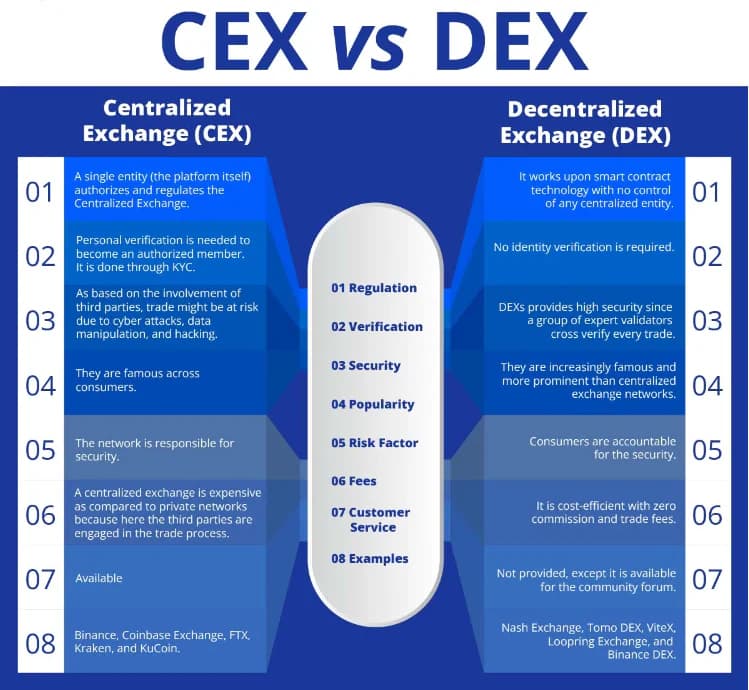
Centralized Exchanges (CEX) and Decentralized Exchanges (DEX) are two different types of cryptocurrency exchanges that operate in distinct ways.
The main differences between CEX and DEX are:
- Centralization: CEXs is centralized, meaning that they are controlled by a central authority. In contrast, DEXs operates on a decentralized network and are not controlled by a central authority.
- Control of assets: In a CEX, users deposit their assets into the exchange's custody, and the exchange is responsible for managing and securing these assets. In a DEX, users maintain control over their own assets, as they are stored in a decentralized wallet.
- Trade execution: Trades on CEXs are executed by the exchange's infrastructure, which matches buyers and sellers in real time. In a DEX, trades are executed directly between buyers and sellers, without the help of a central authority.
- Liquidity: CEXs generally have higher liquidity compared to DEXs, meaning that users can buy and sell large volumes of cryptocurrencies quickly and easily.
- User experience: CEXs typically have a more user-friendly interface and offer a better user experience compared to DEXs.
- Privacy: CEXs often require users to provide personal information, such as their name and address, in order to use the platform. In contrast, DEXs offer greater privacy, as users do not need to provide personal information and trades are executed directly between buyers and sellers.
Conclusion
Demand for decentralized financial applications (DeFi) has spurred decentralized transactions (DEX). This trading venue is a cryptocurrency exchange without a central authority. DEX, one of many decentralized programs, allows bitcoin trading. Users can trade without signing in and always have access to their private credentials.
CEXs are centralized exchanges. Owned-equipment cryptocurrency exchanges are CEXs. Exchanges are administered externally, unlike DEXs. Centralized exchanges entice users with high liquidity and fast transaction exchange. However, the consumer has no control over his login data and relies on the transaction.
Transactions have pros and cons. CEX's success strongly recommends conventional platforms for many traders. Additionally, several CEX has noticed the authority distributed via decentralized trading and are improving their own versions or incorporating DEX capabilities into their networks. Thus, the two versions will combine at viable interfaces.
CEXs and DEXs are two different types of cryptocurrency exchanges that offer unique advantages and disadvantages, and the best option for a user will depend on their individual needs and priorities, such as security, privacy, liquidity, and ease of use.
If you aspire to become a pro-crypto trader, then you have clicked at the right place. CoinScreener.ai advanced technical analysis and AI-generated signals, rich data sources from more than 1000 Future & Spot markets enriched by Machine Learning, and major cryptocurrency exchanges in the world to screen for market trading signals, monitor and analyze the trading behavior of Whales, Top Traders to identify the best market trends in real-time and make the most profit from your trade today.
Follow CoinScreener: https://linktr.ee/coinscreener.ai
#coinscreener #coin #screener #coinscreener.ai #crypto #ai #cryptosignals #cryptocoin #token #cryptoscreener #screenerapp #screenertool #tradingsignals #aitradingsignals #technicalanalysisscreener #technicalanalysis #tradingbot #cryptohopper #cryptobot #dcabot #robot #calculatorcrypto #btc #binance #liquidations #fundingrate #cryptoscreener #btcliquidation #cryptoliquidation #Liquidation #future #futuretrading #cryptocalculator #costbasic #fed #FOCM #Federalreserve #CEX #DEX