
The "ask" price is the lowest price at which sellers are willing to sell, while the "bid" price is the highest price at which buyers are willing to buy (the highest price at which buyers are ready to buy).
The impact of the bid-ask spread and how to manage it are topics covered in this article.
Let's dive in.
What Is The Bid-Ask Spread
In cryptocurrency trading, the bid-ask spread refers to the difference between the highest price that a buyer is willing to pay for a particular asset (the bid price) and the lowest price at which a seller is willing to sell the same asset (the ask price).
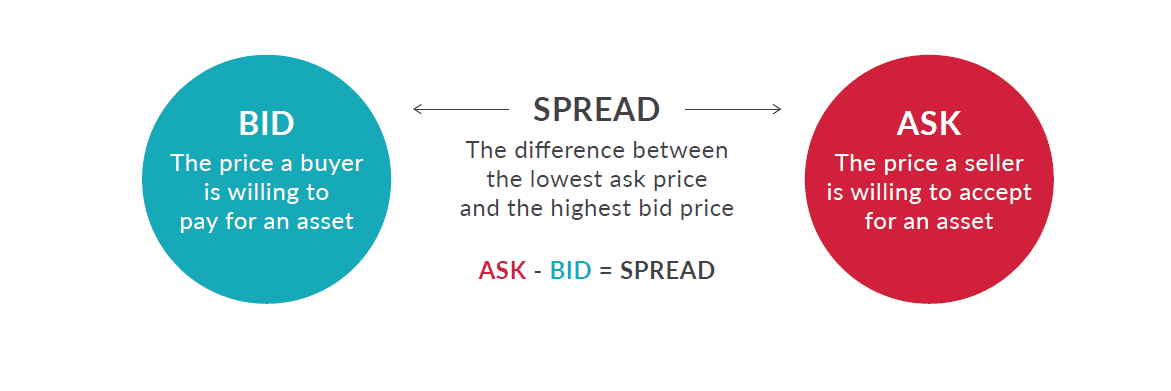
For example, if the current bid price for a cryptocurrency is $10,000 and the ask price is $10,100, then the bid-ask spread would be $100. This means that if you want to buy the cryptocurrency at the current market price, you would have to pay $10,100, which is $100 more than the highest price that sellers are willing to accept.
The bid-ask spread is an important factor to consider when trading cryptocurrencies because it affects the cost of executing a trade. The wider the bid-ask spread, the more expensive it is to buy or sell a particular asset. Therefore, traders often look for cryptocurrency exchanges with narrow bid-ask spreads to minimize their trading costs.
Liquidity and the Bid-Ask Spread
The bid-ask spread is closely related to liquidity in financial markets, including the cryptocurrency market. Liquidity refers to the ability of an asset to be quickly bought or sold without significantly affecting its price.
In general, a narrow bid-ask spread indicates that there is high liquidity in the market for a particular asset. This means that there are many buyers and sellers willing to trade the asset, which makes it easier to buy or sell without affecting its price.
Conversely, a wide bid-ask spread suggests that there is low liquidity in the market for the asset. This means that there are fewer buyers and sellers in the market, which makes it more difficult to buy or sell without affecting its price.
Therefore, traders often prefer assets with narrow bid-ask spreads because they are more liquid and easier to trade. Assets with wide bid-ask spreads may be less attractive to traders because it can be more difficult to enter and exit positions without affecting the market price of the asset.
In summary, the bid-ask spread is an important measure of liquidity in the cryptocurrency market, and a narrow spread generally indicates higher liquidity, while a wide spread indicates lower liquidity.
How to Calculate The Bid-Ask Spread Percentage
The bid-ask spread percentage is calculated by taking the difference between the ask and bid price of an asset and dividing it by the ask price, and then multiplying by 100 to express it as a percentage. The formula for calculating the bid-ask spread percentage is as follows:
Bid-Ask Spread Percentage = ((Ask Price - Bid Price) / Ask Price) x 100%
For example, if the current ask price of a cryptocurrency is $10,100 and the bid price is $10,000, then the bid-ask spread would be $100. To calculate the bid-ask spread percentage, we would divide $100 by $10,100 and multiply by 100 to get:
Bid-Ask Spread Percentage = (($10,100 - $10,000) / $10,100) x 100% = 0.99%
This means that the bid-ask spread percentage for this cryptocurrency is 0.99%, which represents the cost of executing a trade for this asset. It's important for traders to consider the bid-ask spread percentage when trading as it can have a significant impact on their overall trading costs.
How Does Bid-Ask Spread Work?
The bid-ask spread represents the difference between the highest price that a buyer is willing to pay for an asset (the bid price) and the lowest price that a seller is willing to sell the same asset (the ask price). This spread exists because buyers want to pay as little as possible for the asset, while sellers want to receive as much as possible for it.
When a trader places a market order to buy an asset, they will execute the trade at the current ask price. Conversely, when a trader places a market order to sell an asset, they will execute the trade at the current bid price. This means that the bid-ask spread represents the cost of executing a trade for the trader, as they are paying a premium to buy or receiving a discount to sell.
For example, suppose that the current bid price for a cryptocurrency is $10,000, and the current ask price is $10,100. If a trader wants to buy the cryptocurrency at the current market price, they will have to pay $10,100, which is $100 more than the highest price that sellers are willing to accept. Conversely, if a trader wants to sell the cryptocurrency at the current market price, they will receive $10,000, which is $100 less than the lowest price that buyers are willing to pay.
The bid-ask spread can fluctuate in response to changes in market conditions, such as changes in supply and demand. For example, if there are more buyers than sellers in the market, the bid-ask spread may narrow, as sellers may be more willing to sell at lower prices to meet demand. Conversely, if there are more sellers than buyers in the market, the bid-ask spread may widen, as buyers may have to pay higher prices to attract sellers.
In summary, the bid-ask spread is an important factor to consider when trading cryptocurrencies, as it represents the cost of executing a trade and can fluctuate in response to changes in market conditions.
Why is there such a wide gap between the bid and the ask price?
A bid-ask spread can be high due to various factors that affect the supply and demand of an asset, including cryptocurrencies. Here are some of the factors that can cause a high bid-ask spread:
- Low Liquidity: When there is a low level of trading activity for an asset, the number of buyers and sellers in the market decreases, which can lead to a wider bid-ask spread. With fewer buyers and sellers, it can become more difficult to execute trades at the current market price, which increases the cost of trading and leads to a wider spread.
- Market Volatility: Rapid changes in the market price of an asset can lead to a wider bid-ask spread. This is because buyers and sellers may be hesitant to trade at the current market price when there is high volatility, leading to wider spreads.
- Market Makers: Market makers are individuals or institutions that provide liquidity to a market by quoting both bid and ask prices for an asset. In some cases, a high bid-ask spread may be due to a lack of market makers in the market, which can limit liquidity and lead to wider spreads.
- Trading Fees: Trading fees can also contribute to a wider bid-ask spread. When fees are high, traders may be less willing to trade at the current market price, leading to a wider spread.
- Asset Characteristics: Some assets, such as thinly traded cryptocurrencies or those with limited trading volume, may have naturally wider bid-ask spreads due to their unique characteristics.
In summary, a high bid-ask spread can be caused by a range of factors that affect the supply and demand for an asset, including low liquidity, market volatility, the availability of market makers, trading fees, and the unique characteristics of the asset.
Conclusion
Cryptocurrency trading is risky yet profitable. Besides market volatility, the bid-ask spread can cause trading losses. Consider these trading costs when making trade decisions. With large-volume deals, the average bitcoin price may be higher or lower than predicted.
Financial markets are designed to give traders as many trading possibilities as possible, but market participants determine slippage and its impact. To maximize earnings, informed traders focus on liquidity limitations.
If you aspire to become a pro-crypto trader, then you have clicked at the right place. CoinScreener.ai advanced technical analysis and AI-generated signals, rich data sources from more than 1000 Future & Spot markets enriched by Machine Learning, and major cryptocurrency exchanges in the world to screen for market trading signals, monitor and analyze the trading behavior of Whales, Top Traders to identify the best market trends in real-time and make the most profit from your trade today.
Follow CoinScreener: https://linktr.ee/coinscreener.ai
#coinscreener #coin #screener #coinscreener.ai #crypto #ai #cryptosignals #cryptocoin #token #cryptoscreener #screenerapp #screenertool #tradingsignals #aitradingsignals #technicalanalysisscreener #technicalanalysis #tradingbot #cryptohopper #cryptobot #dcabot #robot #calculatorcrypto #btc #binance #liquidations #fundingrate #cryptoscreener #btcliquidation #cryptoliquidation #Liquidation #future #futuretrading #cryptocalculator #costbasic #fed #FOCM #Federalreserve #CEX #DEX #KYC #RSI #indicator #P2P #gridtrading #perpetualcontracts #perpetualfutures #slippage #offchain #onchain #halving #bulltrap #beartrap #Bidask #spread